
Buying Guides
What a FloorScore certificate actually tells you
Check product identity, scope and status before turning a certification logo into a purchasing decision.
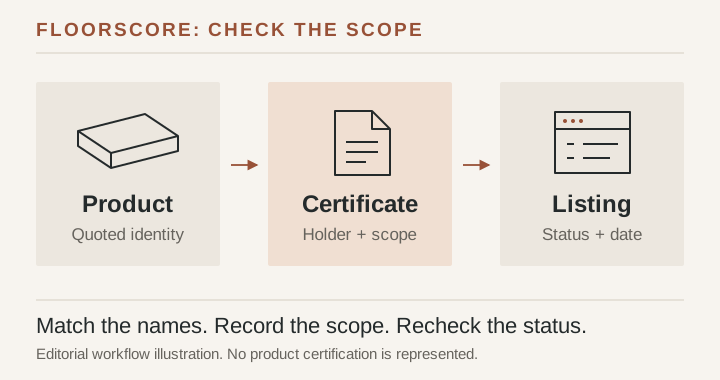
Confirm the product and certificate scope.
Check the current listing.
An emissions certificate is not a universal quality mark.
A certification logo is a starting point for a document check. The useful question is whether the product being offered is covered by the certificate you have received, for the claim you need to support, at the time you intend to purchase it.
For a buyer collecting proposals from several factories, a short verification record is more useful than a folder of unexplained logos. It lets another colleague repeat the check and understand what remains unresolved.
Start with the claim you need
FloorScore is an indoor air quality certification programme covering eligible flooring materials, adhesives and underlayments. SCS describes an assessment involving product emissions testing, product information and manufacturing quality controls. This is a defined certification scope, not a general rating of every aspect of a factory. SCS FloorScore overview.
Before requesting documents, write down the claim your project requires. For example, you may need evidence supporting an indoor emissions requirement for a named floor. Keep separate requests for characteristics such as acoustic performance, fire classification or abrasion performance. A document can be relevant and still leave those other questions unanswered.
Match the certificate to the offer
Ask for the complete certificate and any accompanying product schedule. Keep the original file, its source and the date received. Then compare it with the quotation and technical sheet, paying attention to names that are similar without being identical.
A practical checking sheet can use five rows:
| Question | What to record |
|---|---|
| Who holds the certificate? | The legal entity and any named brand |
| What does it cover? | Listed product families, references and limitations |
| Which document is it? | Certificate identifier and issue or validity details |
| What is being purchased? | Your quoted product code and construction |
| What remains unclear? | The specific mismatch and who will resolve it |
This is an editorial document-control workflow, not a replacement for the certification body’s interpretation. If a product code is absent or a description is ambiguous, ask the holder or certifier to clarify the relationship. Do not fill the gap by assuming that every floor sold under the same logo is covered.
Verify through the issuer
SCS provides a public Certified Green Products Guide with product search and filters for certification, manufacturer and country. Use the issuer’s directory as the next check, rather than relying only on a screenshot supplied with a quotation. Open the SCS directory.
Record the listing you found, the date checked and the identifier that connects it to the supplied document. A missing search result needs investigation: spelling, private-label naming or another unresolved detail may be involved. Mark the claim “verification pending” while seeking clarification. Do not treat a failed keyword search as proof of deception.
Keep private-label names explicit
SCS offers a FloorScore private-label route, with an assessment for customers rebranding certified products and a separate certificate upon approval. A supplier’s certification therefore should not be presented as automatic permission to apply the mark to a buyer’s new brand. SCS private-label guidance.
For an own-brand programme, include the proposed sales name in your document request early. Assign responsibility for the certification relationship, approved wording and label artwork before cartons are printed. Keep the production product reference and the sales reference linked in your internal record, so later changes do not break that connection.
Read the limits before writing the claim
SCS states that FloorScore is based on VOC emissions and does not include phthalate content within its scope. A FloorScore logo therefore does not establish a phthalate-content claim. Request the appropriate supporting evidence if your specification includes that separate requirement. SCS programme FAQs.
Use equally precise language elsewhere. “Certificate supplied” describes receipt. “Document verified” should describe a completed check with a recorded scope. Neither wording means that a member of our team visited the factory or tested the shipment. Those are different evidence types and deserve separate records.
Keep the record current
The SCS-105 standards page describes continuing assessment through annual audits. Certification is not a one-time document to file indefinitely without revisiting its status. SCS-105 assurance information.
Build a recheck into your buying process before relying on the claim for a new programme or repeat order. Ask about changes to the product, manufacturing arrangement or sales identity, and retain the answer alongside the relevant certificate. Where the document and offer no longer line up, reopen the question instead of carrying forward an old conclusion.
A useful record ends with a plain sentence: what was checked, which product it covered, when it was checked and what still needs confirmation. The evidence methodology explains how those distinctions belong in a factory profile.
Sources & further reading
Authorship, affiliations & disclosure
AI-assisted editorial research prepared from the linked primary sources on 19 September 2026. No named technical reviewer or independent product testing is represented. This guide does not certify any product or facility, and does not establish compliance for a particular project.
Corrections & editorial informationContinue exploring.
The reading room
Read the certificate, not the badge.
The company, product, site and dates behind a flooring certificate matter more than the logo on a supplier presentation.
Read the feature
A panel is more than its surface.
PVC wall panels begin with a sheet. A successful specification includes the substrate, joints, fixing method and intended application.
Read the feature
A similar surface is not the same design.
From an inspiring image to a supplier film reference: the checks between a visual match and something you can actually order.
Read the feature