
Guide / Country comparison
Vietnam vs China SPC flooring: what an importer should weigh
Vietnam supplied 46.1% of US vinyl flooring imports in 2025, China 14%. How duty, origin proof, supply depth and MOQ compare, from official data.
Short answer
For US-bound SPC, Vietnam wins on duty only while Vietnamese origin holds: Chinese-origin vinyl tile carries an additional 25% Section 301 duty that Vietnamese origin does not. China keeps the deeper supply base and is still the largest supplier of vinyl flooring to the UK, Canada, Australia and Germany. Move a range when the Vietnamese plant extrudes the core itself and can document it.
Vietnam went from 0.6% to 46.1% of US vinyl floor imports (HS 3918.10) between 2019 and 2025, while China fell from 84.0% to 14.0% (UN Comtrade).
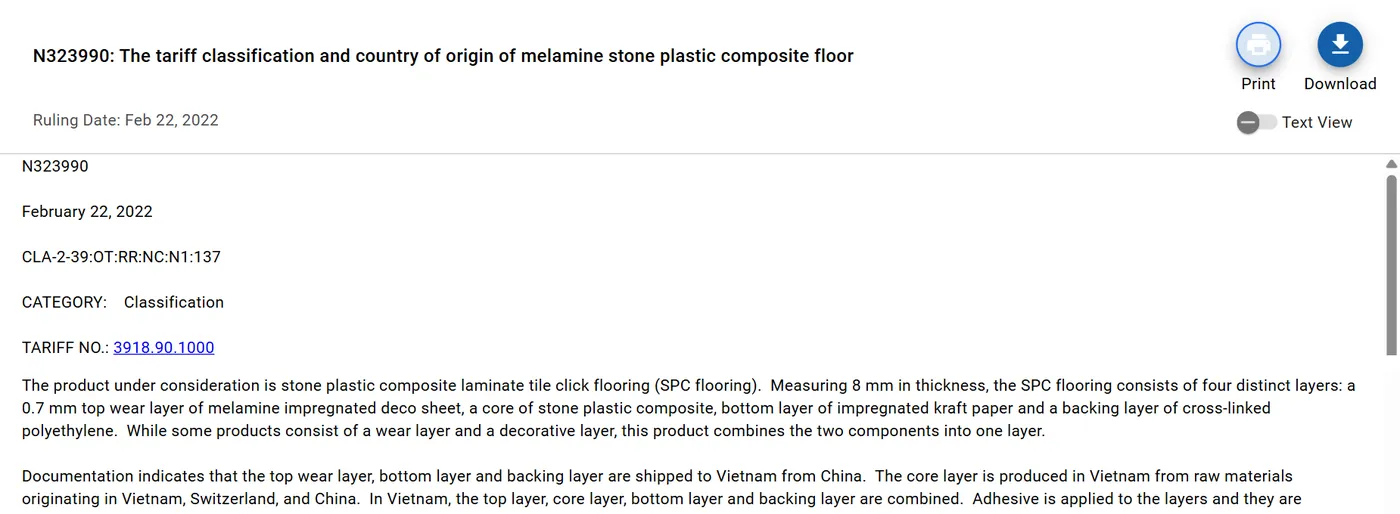
In CBP ruling N323990, SPC with Chinese surface and backing layers was Vietnamese origin because the core was made, pressed, cut and profiled in Vietnam.
Of the 13 Vietnam factory records we publish, one states a standard MOQ and none publishes a lead time, as of November 2026.
How do Vietnam and China compare for SPC flooring today?
For US buyers the market has already moved. Vietnam supplied 46.1% of US imports of vinyl floor coverings (HS 3918.10) by value in 2025 and China 14.0%, against 0.6% and 84.0% in 2019. Vietnam passed China in 2024. Elsewhere, China is still the default supplier.
UN Comtrade data for 2025 show how US-specific the shift is. China was the largest supplier of HS 3918.10 to every other market we checked: 41.5% of UK imports, 58.3% of Canada’s, 60.5% of Australia’s and 52.1% of Germany’s. Vietnam’s share in those markets ranged from 0.6% to 7.3%.
What each factor looks like for a US-bound SPC programme, as of November 2026. Sources: UN Comtrade, CBP rulings, USITC tariff schedule and our factory records.
| Factor | Vietnam | China | What decides it for your order |
|---|---|---|---|
| US duty | 12.5% Section 301 duty; no List 3 duty | 12.5% Section 301 duty plus the 25% List 3 duty (heading 9903.88.03) | Where the core is made and the plank finished |
| Duty stability | The 12.5% duty applies from 24 July 2026 | List 3 heading in place since the 2018 action; the 12.5% since 24 July 2026 | Your contract’s duty clause |
| Origin risk | Exposed if the plant buys in finished board | Not an issue | Production records for your lot |
| Supply depth | Large in the US trade, thin elsewhere | Largest supplier to most other markets | Plant capacity and décor library |
| Published terms | 1 of 13 records states an MOQ; none a lead time | Not covered by our records | A dated, written quotation |
How large is the duty difference, and how stable is it?
On US entries, Chinese-origin vinyl tile under 3918.10.10 pays an extra 25% Section 301 duty under heading 9903.88.03 that Vietnamese origin does not. Both origins pay the same 12.5% Section 301 duty (headings 9903.05.31 for China and 9903.05.84 for Vietnam). The List 3 gap is the whole duty case for Vietnam. Current rates, the stacking rules and what is being challenged in court sit on our US tariff monitor for Vietnam SPC.
The two duties differ in age. The List 3 heading comes from the September 2018 modification of the China Section 301 action (83 FR 47974). The 12.5% applies only to goods entered from 24 July 2026, under a USTR notice covering 60 economies (91 FR 47318) that found each had not imposed and enforced a ban on forced-labour imports.
So the extra China cost has been predictable for years, while the 12.5% both origins pay is new and has a shorter record. A buyer moving a range for duty should price with today’s rates and write a clause that says who carries a change in either direction.
What protects the Vietnam duty position?
Origin, decided by where the floor is made, not where it ships from. Under US rules, further work in another country changes origin only if it substantially transforms the goods. CBP’s SPC rulings turn on which steps happened where, and each binds only the facts it describes, so your process has to stand up on its own.
N323990 is the pattern most Vietnamese plants describe: imported layers, a core made in Vietnam from Vietnamese, Swiss and Chinese raw materials, then pressing, cutting and click profiling there. N350880 went further, accepting cutting, profiling and padding of imported sheets as enough. We would not build a programme on that second pattern without a ruling in the importer’s own name.
The risk runs to the importer. Under 19 U.S.C. 1592 a material false statement on entry can be penalised for negligence alone, not only fraud. Our origin evidence workflow sets out the records to collect before the order.
Do Chinese inputs or a Chinese parent change the comparison?
Neither decides origin on its own. Imported layers are common, and some Vietnamese SPC plants have Chinese parents, yet N323990 accepted Chinese layers inside a Vietnamese-origin plank. What matters is whether the core is made in the plant that ships your order, and whether the group can quietly move volume back to China.
Resin is one input where China does not dominate. Vietnam’s 2023 imports of PVC resin (HS 3904.10, all uses) came 27.5% from Taiwan, 19.2% from China, 16.4% from Indonesia and 13.5% from the US, by value. A plant’s own resin record still matters more than the national mix, for origin and for forced-labour checks.
Ownership matters for a different reason: in a group with plants in both countries, one sales team can quote either. The ownership grades for each plant are on our page on who owns Vietnam’s SPC factories.
Where is supply deeper, and what does that do to lead times and MOQ?
China has the deeper base: it still leads supply to most import markets outside the US. Vietnam’s US trade in vinyl flooring was built mostly since 2019, and few plants publish commercial terms. Lead time belongs in the quotation, plant by plant.
Of the 13 Vietnamese factory records we publish, reviewed between October and early November 2026, only ATT states a standard MOQ (generally one full container, in its September 2026 factory article). None publishes a lead time. We hold no comparable records for Chinese plants.
For a buyer this means MOQ per décor, sample approval time and production slots are negotiated, not looked up. Ask for them in writing with a date, and ask which décors are already in the plant’s film library, since a new décor adds film development before the first run.
What changes in the quote when you move from China to Vietnam?
The product price is only one line. A Vietnam quote should also name the producing plant and address, the origin documents the plant will supply per shipment, and the duty clause. Clauses that a long-standing Chinese supplier never needed become essential once the duty saving depends on origin.
Fields to add or tighten when the same SPC range is requested from a Vietnamese plant. Our purchasing checklist, not a legal requirement.
| Quote field | China programme (typical) | Vietnam quote should add |
|---|---|---|
| Producing site | Often the supplier’s only plant | Named plant and address; no site change without approval |
| Core | Rarely questioned | Confirmation the core is extruded in that plant |
| Origin documents | Certificate of origin | Bill of materials, resin records and lot production records |
| Duty change | Long-settled | Who carries a change in the Vietnam rate |
| MOQ and décors | Known from past orders | MOQ per décor and which films are in stock |
Worked example: splitting a range between the two countries
Illustrative figures only. A US importer buys 12 containers a year of one SPC range in 8 décors from a Chinese plant. A Vietnamese plant offers the same construction with a one-container MOQ per décor and extrudes its own core.
| Illustrative décor group | Containers a year | Decision |
|---|---|---|
| 5 best-selling décors | 9 | Move to Vietnam after a trial container per décor family |
| 3 slow décors | 3 | Stay in China for now; below one container each per order |
| First Vietnam order | 2 of the 9 | Two décors, approved against the current China reference sample |
Outcome: 9 of 12 containers carry the duty advantage, the slow décors avoid forced MOQ stock, and the buyer keeps a working Chinese supplier. The Vietnam purchase order names the plant and requires lot records for every shipment.
Our view
For US-bound SPC we would move the high-volume part of a range to a Vietnamese plant that extrudes its own core and can show resin and lot records, and keep a smaller Chinese line running. Dropping China entirely trades a known duty for an unknown supply risk. Outside the US, we would stay with the best plant, wherever it is.
Two things would change our mind on a given plant: a refusal to name the producing site in the order, or a core bought in from another factory. The wider country decision is set out in our China plus one flooring guide.
If Thailand is also on your list, read how Vietnam and Thailand compare for SPC.
Common mistakes when comparing Vietnam and China
Most mistakes come from treating a country as a supplier. The duty saving, the MOQ and the lead time belong to one plant and one product, and the comparison breaks when any of them is assumed from the country label.
| Mistake | What it costs | How to avoid it |
|---|---|---|
| Assuming a Vietnamese invoice means Vietnamese origin | China duty layers, plus possible penalties | Get lot production records and the plant address |
| Relying on someone else’s CBP ruling | No cover for your process | Compare your process to the ruling, or ask for your own |
| Moving every décor at once | MOQ stock on slow décors | Move high-volume décors first |
| Pricing with the duty saving built into the factory price | Hidden origin risk | Keep factory price and duty as separate lines |
| Dropping the Chinese supplier on day one | No fallback if the new plant slips | Keep a smaller line running until repeat orders are stable |
More plant-level research is collected under find factories.
If you want a shortlist of Vietnamese plants that extrude their own core, with the origin questions already asked, our factory selection support works on that basis.
Questions buyers ask
Can I ask the factory to apply for a CBP origin ruling?
The factory can supply the process description, but the request usually comes from the importer side. In N323990 it was filed by counsel for the importer. Agree with your broker who files, and get the factory to sign off the process facts first.
What happens if CBP treats a Vietnamese shipment as Chinese origin after entry?
The China duty layers apply to that entry, and a false origin statement can also bring a penalty claim against whoever entered the goods. Your contract should say who pays in that case and which records the factory must hand over.
Is SPC from Vietnam cheaper than SPC from China?
We do not publish prices. Ask both plants to quote the same written construction on the same Incoterm, then add duty for each origin separately. A factory price comparison that already includes an assumed duty saving hides the origin risk.
Does the comparison change if I sell in Europe or Australia?
Yes. The Section 301 layers are US measures. In other markets the duty difference between the two origins depends on that country's tariff and any trade agreement, so the case for Vietnam may rest on supply alone. Check with your broker before moving.
What if a Chinese-owned plant in Vietnam fills my order from its China factory when busy?
Then the goods are Chinese origin, whatever the invoice says. Name the producing plant and address in the purchase order, ask for production records for your lot, and treat any change of site as a new approval.
Sources & further reading
- UN Comtrade: imports of HS 3918.10 by partner (US, UK, Canada, Australia, Germany), annual 2019 to 2025, checked November 2026
- CBP ruling N323990 (22 February 2022): country of origin of SPC flooring made in Vietnam
- CBP ruling N350880 (15 July 2025): country of origin of SPC planks finished in Panama
- Federal Register 91 FR 47318 (28 July 2026): Section 301 actions on 60 economies
- USITC Harmonized Tariff Schedule, Chapter 99, U.S. notes 20(f) and 52 (2026)
Authorship, affiliations & disclosure
Prepared from the official sources listed and our own factory records, checked 10 November 2026. The worked example is illustrative. Duty rates are kept on our US tariff monitor. This is purchasing guidance, not a customs ruling or legal advice.
Corrections & editorial informationContinue exploring.
All guides in Find factories
China plus one flooring: stay in China, go to Vietnam or add Thailand
Stay in China, move to Vietnam or add Thailand: US duty exposure, origin risk, cost drivers and factory depth from 32 directory records, November 2026.
Read the feature
Who owns Vietnam's SPC flooring factories, and is your floor really made in Vietnam?
Vietnamese, Chinese or international? Graded ownership for published Vietnam SPC factory records, and why US origin depends on where the floor is made.
Read the feature
Buying SPC from AMY Grupo: which plant makes your order
AMY merged its SPC1 plant into SPC2 in 2023. What that means for quotations and test reports, and the documents to request before ordering SPC from AMY Grupo.
Read the feature