
Buying Guides
How to read a factory record
Connect a Vietnam flooring company to its producing site, product documents and evidence before qualifying an SPC supplier.
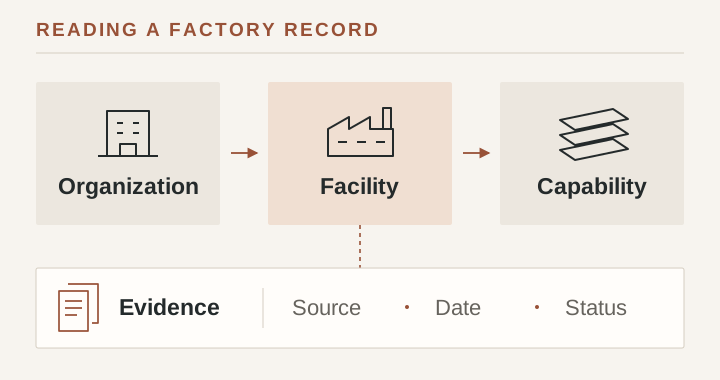
A company and a physical site are different records.
A manufacturer statement is not an observed fact.
Keep scope, sources and missing information visible.
A useful factory record helps you decide what to ask next. Start with the physical facility, then inspect the claims that matter to your product.
Identify the physical site
Check the operator and location. A group name, trading brand and production facility are not interchangeable. If the address is unknown, keep that gap visible. For example, NEO FLOOR describes its Factory No. 1 and No. 2 separately; our SPC record belongs to the second site. Official factory descriptions.
Begin with three names: the brand you found, the legal company that will quote, and the company operating the proposed production site. They may be connected, but the connection should be established rather than assumed. Keep the source wording of the address as well as its current location description. An older province name can remain on a historical certificate even when newer company material uses a revised administrative address.
Use the northern Vietnam manufacturing view to orient a shortlist. Its area markers help you understand the cluster; they are not verified gates, confirmed visit appointments or evidence that a particular line is operating today.
Read the construction
Your program depends on installation, dimensions, panel thickness, wear layer, pad, finish and performance requirements. A record documenting SPC does not establish every possible SPC configuration.
Write the proposed product as a construction, not just a collection name. Distinguish panel thickness excluding attached pad from total finished thickness. Record the wear layer, underlay material and grade, locking system, surface treatment and dimensions. Preserve the sample or technical-sheet revision used in the conversation.
A technology announcement can establish a narrower point about a named platform. It is a reason to ask about that platform, not evidence that every collection from a manufacturer has the same composition or licensing scope. Retain the named product, announcement date and supporting technical documents beside the proposed construction.
Follow the evidence
Read the source date, review date and scope. A manufacturer statement remains a statement. A visit report describes what was observed on that visit. A certificate needs its own scope and validity review. For FloorScore documents, use the issuer’s product directory and match the actual product, not just a familiar company name.
For each document, retain its number, holder, named site, product scope and printed dates. Then record what you actually checked: a badge in a catalogue, a complete file, a distributor’s copy or an issuer entry. An issuer listing can point to an older PDF; preserve both observations until the current revision is resolved. A file whose printed dates have not expired still needs to match the selected construction and producing site.
Different documents also answer different questions. Hengli’s LVT FLOORING EPD entry concerns an environmental declaration for LVT. It does not establish SPC coverage or replace product testing and supplier qualification. The certificate-reading guide explains how to keep those scopes separate.
Keep unknowns visible
Missing documentation is a question to resolve. It is not proof that a facility cannot offer a product. An unknown field is not a supported capability match.
Apply the same discipline to scale. A group workforce is not a Vietnam plant workforce. A mixed-product output figure is not SPC-only capacity. Container shipments, stated annual capacity, actual output and available production slots are different measurements. A useful comparison retains those labels and leaves incompatible numbers out of a combined ranking.
Trade research can suggest another company to investigate, but a shipper name does not identify a physical plant by itself. Keep raw names and dates beside any provisional company match. An absent annual count remains unknown, and overlapping aliases should not be added together. See how to investigate Vietnam SPC export evidence before treating a shipment footprint as supplier approval.
Convert the gaps into a brief
Compare facilities against your requirement. Carry the shortlist into a product specification, then request current quotations or a defined verification scope.
Keep the first follow-up short: name the product, identify the proposed producing site, request the current documents for that construction and ask the factory to resolve the specific gaps. Record who answered and when. If you need samples or a visit, define what those steps must establish before committing to a programme.
For an alternative supplier, carry the existing approved specification into the comparison rather than substituting a similar catalogue item. Our second-source research guide provides a starting point. A free first call with our team can help turn open questions into an agreed next step.
Explore the index or read the methodology.
Sources & further reading
Authorship, affiliations & disclosure
AI-assisted platform guide. It explains a procurement workflow; it is not a factory visit, certification or a statement of market prices.
Corrections & editorial informationContinue exploring.
The reading room
Read the certificate, not the badge.
The company, product, site and dates behind a flooring certificate matter more than the logo on a supplier presentation.
Read the feature
A panel is more than its surface.
PVC wall panels begin with a sheet. A successful specification includes the substrate, joints, fixing method and intended application.
Read the feature
A similar surface is not the same design.
From an inspiring image to a supplier film reference: the checks between a visual match and something you can actually order.
Read the feature