
Guide / Container loading
How many m² of SPC flooring fit in a 20ft or 40ft container?
SPC containers fill by weight, not volume. Weight per m² by thickness, container payloads, US road limits and a worked example for a 20ft and a 40ft high cube.
Short answer
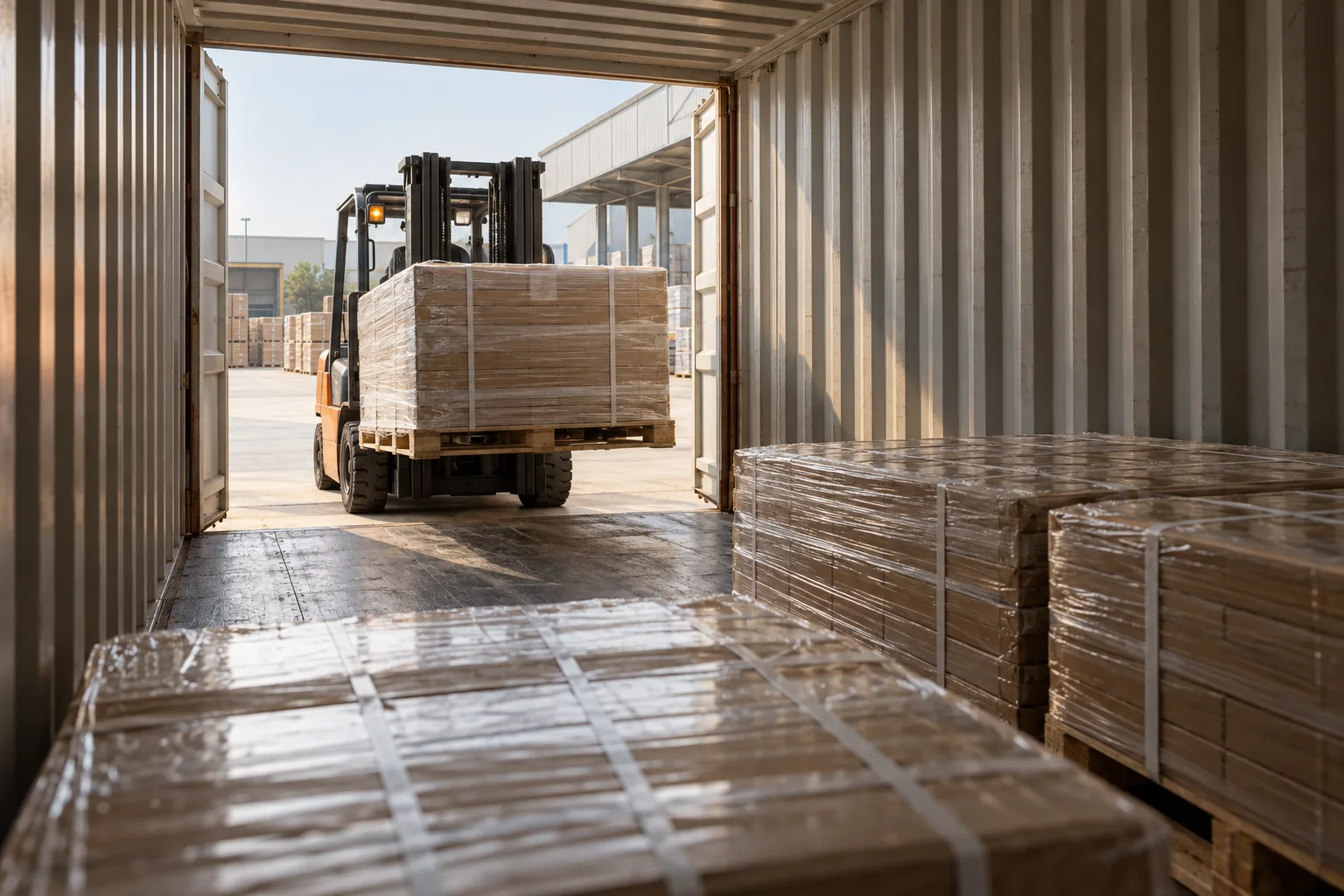
For 5 mm SPC trucked inland in the US, plan on about 1,980 m² in a 20ft and 2,310 m² in a 40ft high cube (our worked example below). The road weight limit binds long before the box is full. In our view the 20ft is the default box: the 40ft high cube pays only if its delivered cost is less than about 16.5% above the 20ft. Build the plan from the factory gross weight per carton.
Plan m² per container from gross kg per carton and the road limit at destination, and get the factory's loading plan with weights before it packs.
Under US road limits a 40ft high cube is cheaper per m² only if it costs less than about 16.5% more than a 20ft, delivered.
Extra core thickness is what you pay to ship; going from 5.0 to 6.6 mm raises freight per m² by about 13%.
Why does the m² figure in your quote matter so much?
Because freight per m² is the container cost divided by that figure, and most quoted figures are too high. A 20ft has room for about 6,620 m² of 5 mm board by volume (33.1 m³ ÷ 0.005 m), but that would weigh about 53 t. For SPC the only question that counts is how much weight this container can carry on your route.
What can the container itself carry?
One carrier’s published figures for dry containers. Individual units differ, so check the plate on the actual box.
| Container | Inside length × width × height (mm) | Capacity (m³) | Tare (kg) | Max payload (kg) |
|---|---|---|---|---|
| 20ft dry | 5,898 × 2,350 × 2,390 | 33.1 | 2,150 | 28,330 |
| 40ft dry | 12,032 × 2,350 × 2,390 | 67.6 | 3,640 | 26,840 |
| 40ft high cube | 12,032 × 2,350 × 2,695 | 76.2 | 3,700 | 28,800 |
Source: ONE container information, checked October 2026.
The 40ft high cube has more than twice the space of the 20ft and almost the same payload. For SPC, the extra space is mostly air.
What does the US road allow?
For US deliveries the road, not the box, usually sets the limit. The federal Interstate limit is 80,000 lb gross vehicle weight, and that includes the tractor, the chassis and the empty container.
One US forwarder gives the practical line: in most states, cargo above 37,500 lb (about 17,010 kg) in a 20ft, or above 43,500 lb (about 19,730 kg) in a 40ft, counts as heavy. Above that you may need a tri-axle chassis, a permit or a transload at the port, and some states issue no overweight permits at all. Treat these as planning figures. Get the real target for your warehouse from your forwarder, and ask the Vietnam side whether the factory-to-port trucking leg has its own limit.
How much does SPC weigh per m² by thickness?
Weight depends on the core recipe, the pad and the packaging, not only on thickness. These are weights stated on published data sheets. Use them for the range, then replace them with the gross kg per carton from your own factory.
| Total thickness | Construction as stated | Weight stated | Weight per m² | Source |
|---|---|---|---|---|
| 4.50 mm | SPC, 0.30 mm wear layer, no pad listed | 7.4 kg/m² | 7.4 kg (board) | Responsive Industries, Inspire |
| 5.0 mm | SPC, 0.50 mm wear layer, no pad listed | 8,000 g/m² | 8.0 kg (board) | Responsive Industries, Resonate |
| 6.60 mm | SPC rigid core, 0.55 mm wear layer | 9.10 kg/m²; 19.7 kg per 2.09 m² box | 9.10 kg (board); 9.43 kg (boxed, our calculation) | Bjelin Rigid Core |
| 7.5 mm | SPC with IXPE foam pad | 42 lb per 17.52 sq ft carton | 11.7 kg (carton, our calculation) | Stock House, Greatmats |
Our calculations: the Bjelin box is 19.7 kg ÷ 2.09 m² = 9.43 kg/m², about 3.6% above the board weight. The Stock House carton is 42 lb = 19.05 kg over 17.52 sq ft = 1.628 m², so 11.7 kg/m².
Weight is also a quality signal. If the packing list, the sample and the approved spec show different weights for the same construction, ask why. A changed core recipe often shows up first as a changed weight. Our guide to comparing SPC quotes line by line shows where the weight belongs in the quotation.
How do you calculate m² per container? A worked example
Use the SPC packing calculator to change the board size, carton weight, pallet layout and cargo limit. It keeps the assumptions visible and accepts measured carton gross weights.
Work from the cargo limit down to m². The board weights come from the data sheets above. The carton and pallet allowances are example figures: 4% for cartons, based on the Bjelin box, and 20 pallets at 25 kg each. Use your own packing list instead.
| Step | Method | 20ft dry | 40ft high cube |
|---|---|---|---|
| 1. Cargo limit, US road | Forwarder’s “heavy” line, converted to kg | 37,500 lb = 17,010 kg | 43,500 lb = 19,730 kg |
| 2. Minus pallets | Example: 20 × 25 kg = 500 kg | 16,510 kg | 19,230 kg |
| 3. Packed weight per m² | 8.0 kg board × 1.04 carton allowance | 8.32 kg/m² | 8.32 kg/m² |
| 4. m² at the road limit | Step 2 ÷ step 3 | about 1,980 m² | about 2,310 m² |
| 5. m² at the box payload | (Payload − 500) ÷ 8.32 | (28,330 − 500) ÷ 8.32 = about 3,350 m² | (28,800 − 500) ÷ 8.32 = about 3,400 m² |
| 6. Volume used at step 4 | m² × 0.005 m³ (board only) | about 9.9 m³ of 33.1 m³ | about 11.6 m³ of 76.2 m³ |
Step 4 is the planning figure for a normal US road delivery. Step 5 is the most the box could take; do not plan an inland delivery on it.
The same method across thicknesses, with the same example allowances:
| Thickness and weight used | m² per 20ft, US road | m² per 40ft HC, US road | m² per 20ft, box payload |
|---|---|---|---|
| 4.50 mm, 7.4 kg + 4% = 7.70 kg/m² | about 2,150 | about 2,500 | about 3,620 |
| 5.0 mm, 8.0 kg + 4% = 8.32 kg/m² | about 1,980 | about 2,310 | about 3,350 |
| 6.60 mm, boxed 9.43 kg/m² | about 1,750 | about 2,040 | about 2,950 |
| 7.5 mm with pad, carton 11.7 kg/m² | about 1,410 | about 1,640 | about 2,380 |
These are our calculations from the cited weights and limits, not a promise from any carrier, trucker or factory.
How should thickness, wear layer and pad be weighed against freight?
Freight per m² moves in step with packed weight. From the table, going from 5.0 mm to 6.6 mm cuts a 20ft from about 1,980 to 1,750 m², so every m² carries about 13% more freight (1,980 ÷ 1,750). Going from 4.5 mm to the 7.5 mm padded board raises it by about half (2,150 ÷ 1,410 = 1.52).
Our view on where to spend:
- Wear layer first. It is a few tenths of a millimetre on a 4 to 7 mm board, so it barely moves the weight, and it is what the end user actually wears through. If the floor goes into heavy use, pay for wear layer before core.
- Core thickness only when the market asks for it. Extra core is the part you pay to ship on every container. If your customers buy on feel underfoot or on subfloor tolerance, it can earn its freight. If it is there because a thicker number looks better in a brochure, it is a cost you carry for nothing.
- Pad on its own merits. The 7.5 mm sheet does not split its weight between core and pad, and we will not guess. Ask the factory for the gross kg per carton with and without pad, and price the freight difference before you decide.
When does a 20ft beat a 40ft high cube?
Under US road limits, the 40ft high cube carries about 16.5% more SPC than the 20ft (2,310 ÷ 1,980). It is cheaper per m² only if its delivered cost (ocean, port, chassis and trucking) is less than about 16.5% above the 20ft. Get both prices to your door, divide by the m² each one really carries, and compare.
If you need more than one box, two 20fts carry about 3,970 m² (2 × 16,510 ÷ 8.32), about 72% more than one 40ft high cube. For a large order, that comparison matters more than the 20ft against the 40ft.
In our view the 40ft high cube earns its place in three cases: your forwarder can deliver it heavier (tri-axle chassis, permit or port transload) and the extra cost still leaves a lower cost per m²; you fill the spare space with lighter goods on the same order; or your destination allows a heavier load than the US figures here.
What should you demand from the factory’s loading plan?
A loading plan per container, before packing starts, with:
- Pieces, m² and gross kg per carton for your exact construction
- Cartons per pallet, pallet weight and pallets per container
- Cartons per decor in each container, so one heavy decor does not push a box over target
- Total cargo weight per container, set against the target your US forwarder gave you
- How the weight is spread along the container floor
- The declared gross mass (VGM) the shipper must give the carrier before loading
- Photos of the loaded container and the seal number
If the factory’s plan shows the box payload instead of your target, send it back. Our pre-shipment inspection checklist covers what an inspector checks, and our pre-shipment inspection service can include loading supervision when you agree it in the scope.
Which factory documents help with this?
The packing list and the carton spec. Most factories send packing data on request; some publish it with their product sheets. When you shortlist plants in the factory directory, ask each one for the same packing data and compare it with the weight in its quotation. The records for NEO FLOOR, Huali Group Vietnam and ANZ Flooring show what each plant has published. Our guide to reading a factory record explains what a record can and cannot tell you.
Common mistakes
- Accepting a round m² figure in the quote. If a quote assumes 2,500 m² of 5 mm per 20ft and the road allows about 1,980, your freight per m² is about 26% higher than the quote implies (2,500 ÷ 1,980).
- Letting the factory pack to that figure. 2,500 m² at 8.32 kg/m² plus 500 kg of pallets is 21,300 kg, about 4,290 kg over the 17,010 kg line. You then pay for heavy delivery or a transload you did not budget for.
- Using the box payload as the plan. The box may carry it; the road at destination may not.
- Comparing one 20ft with one 40ft high cube on box price. Compare cost per m² delivered, at the weight each one can really take.
- Using board weight instead of carton weight. Cartons, pad and pallets add weight a data sheet board figure does not show.
Our view
Ask for gross kg per carton before you compare prices, and recalculate every quote’s freight per m² from your own road limit. For mainstream SPC to US warehouses, we would default to the 20ft and make the 40ft high cube prove itself on delivered cost per m². Spend on wear layer before core, write the target cargo weight into the order, and check it at loading.
If you want help with the packing plan or a loading check, start with our services, or book a pre-shipment inspection that includes the loading.
Questions buyers ask
Do these figures apply to Europe, the UK or Australia?
The method does; the road figures do not. The box payload is the same everywhere, but the cargo weight your truck can carry to the warehouse depends on local rules and equipment. Ask your forwarder for the target cargo weight to your door and rerun step 1 of the worked example.
Can I mix SPC with lighter goods in one container?
Yes, and it is one of the few ways to use the empty space in a 40ft high cube. Plan by weight first: add up gross kg for every line, then check that the light goods actually fit in the space left. Ask the factory to show both on the loading plan.
Is it better to ship SPC on pallets or floor-loaded?
Pallets protect cartons and speed up unloading, but their weight comes off your flooring. Floor-loading saves that weight but is slower to unload and risks crushed corners. Agree the method with your warehouse and write it into the order.
Why do online answers say 3,500 m² fit in a 20ft?
They calculate by volume and forget weight. At about 8 kg/m², 3,500 m² of 5 mm SPC weighs about 28 t before cartons and pallets. That is at the payload limit of the box and far above the US road threshold for a 20ft.
Who checks the loading at the factory?
Agree it in advance. A loading check can be added to a pre-shipment inspection: carton count, condition, weight distribution, photos of the loaded container and the seal number. Loading supervision is usually priced separately from the inspection day.
Sources & further reading
- ONE (Ocean Network Express): container information, dry 20ft, 40ft and 40ft high cube dimensions, tare and payload
- FHWA: federal size and weight limits on the Interstate system (80,000 lb gross vehicle weight)
- Green Worldwide Shipping: when a 20ft or 40ft container counts as heavy for US road delivery (March 2021)
- Responsive Industries: Inspire SPC technical data sheet (4.50 mm, 7.4 kg/m²)
- Responsive Industries: Resonate SPC technical data sheet (5.0 mm, 8,000 g/m²)
- Bjelin Rigid Core technical data sheet via NOBB (6.60 mm, 9.10 kg/m², 19.7 kg per 2.09 m² box)
- Greatmats: Stock House SPC specification (7.5 mm with IXPE, 42 lb per 17.52 sq ft carton)
- Area Floors: SPC technical data sheet (core density 2,000 kg/m³)
Authorship, affiliations & disclosure
Prepared by our team from the sources listed. Weights come from published data sheets; m² per container figures are our calculation from those weights, with example allowances for cartons and pallets marked as such. Confirm the limits for your route with your forwarder.
Corrections & editorial informationContinue exploring.
The reading room
US tariffs on SPC flooring from Vietnam in 2026: what applies today
As of 26 October 2026: the HTS 3918.10 rate, the 12.5% Section 301 duty on Vietnam, the China comparison, AD/CVD, UFLPA and EAPA, with a worked example.
Read the feature
Who owns Vietnam's SPC flooring factories, and is your floor really made in Vietnam?
Vietnamese, Chinese or international? Graded ownership for published Vietnam SPC factory records, and why US origin depends on where the floor is made.
Read the feature
Read the certificate, not the badge.
The company, product, site and dates behind a flooring certificate matter more than the logo on a supplier presentation.
Read the feature