
Find factories / Help on the ground
Flooring sourcing agent in Vietnam: who pays them, when you need one
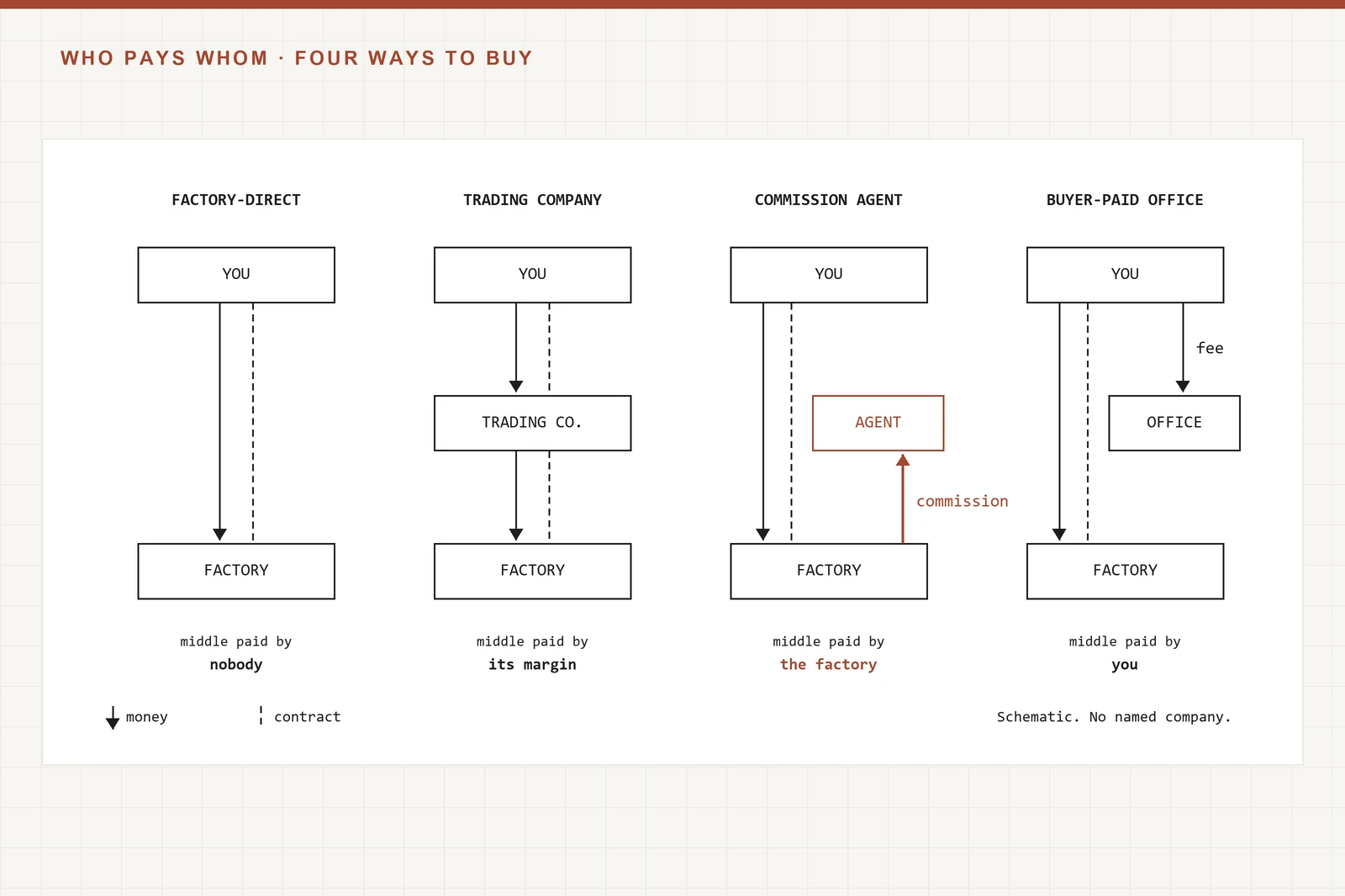
Four ways to buy flooring from Vietnam, who pays the middle party in each, and how a factory-paid commission hides in the price per m².
Short answer
A flooring sourcing agent in Vietnam finds factories, collects quotes and follows the order. What decides whose side the agent is on is who pays it. Many agents are paid a commission by the factory, carried inside your price per m². A buyer-paid office charges you a fee agreed in advance and takes nothing from factories. Ask every agent, in writing, who pays them and how much.
In an illustrative order at USD 6.00 per m², a 4% factory-paid commission adds USD 0.25 to every m², and the commission grows each time the price goes up.
Ask for the pro forma invoice from the factory in your own company name. If an agent will not let the factory invoice you directly, you cannot see what the price contains.
A repeat order from a factory you have already proved, with your own pre-shipment inspection booked, usually needs no agent at all.
Most buyers who search for a flooring sourcing agent in Vietnam want one thing: someone on the ground who can find the right plant and stop a bad container before it leaves. Many people offer that. They differ in who they sign with and who pays them, and those two facts shape every recommendation you will get.
What are the ways to buy flooring from Vietnam?
There are four: buy direct from the factory, buy from a trading company, use a commission agent, or hire a buyer-paid purchasing office. They differ in who you sign the contract with and who pays the middle party. Each one fits some buyers.
The table sets the four models side by side. It describes how each model usually works in the market, not any named company. Individual firms mix models, so ask each one which it uses on your order.
| Model | Who you sign with | Who pays them | What they do | Where the conflict sits | When it fits |
|---|---|---|---|---|---|
| Factory-direct | The factory | Nobody in the middle | Nothing beyond what the factory offers | None in the middle; you carry all checks yourself | Repeat orders, own QC, own people who visit |
| Trading company | The trading company, which buys from the factory and resells | Its margin between factory price and your price | Holds the contract, often consolidates, may finance | Margin and factory choice are hidden; the plant may change between orders | Small or mixed containers, one invoice from a known party |
| Commission agent | Usually the factory, sometimes the agent | The factory, as a percentage of your order | Finds factories, translates, follows production | Income rises with the price and depends on which factory wins | Buyers who accept the trade-off and check the price themselves |
| Buyer-paid purchasing office | The factory, directly | You, at a fee agreed in advance | Factory selection, quotes, production follow-up, inspection | Its fee does not depend on the factory; scope and fee still need writing down | First orders, new origin, private label, no one on the ground |
A trading company can be the right partner when you need one contract for a mixed container. The point to settle is whether you know which plant made your floor. Our research on who owns the SPC plants in Vietnam shows why that matters: the name on an invoice and the plant behind it are often two different companies.
How is a sourcing agent paid, and why does it matter?
Most agents are paid in one of two ways: a commission from the factory, set as a percentage of your order value, or a fee from you, agreed before work starts. Some take both. On some orders the two come to similar amounts. What changes is whose interest the agent serves when the factory price or the factory choice is on the table.
A commission paid by the factory is part of the factory’s cost of selling to you, so it is built into the price you pay. The agent earns more when your price is higher: an agent paid 4% gains from every cent added per m² and loses from every cent you negotiate away. Its income also depends on which factory wins. A plant that pays commission has an advantage over one that does not, whatever its quality.
The commission is usually invisible to you. It sits inside one line, the unit price, on a pro forma invoice you did not draft.
None of this means every commission agent works against you. Many are open about it, and some will show the percentage when asked. The UK government’s guidance on bribery in trade advises buyers to question partners who ask for undocumented fees or refuse to sign contracts. The practical version for flooring: get every payment to every party into writing.
A buyer-paid office has a different pressure. It does not gain from the factory price, but it is paid by you, so it has a reason to make the job look bigger. Fix the scope and the fee in writing before work starts.
What can a flooring-specific office check that a general agent usually cannot?
A general agent can find a factory and count cartons. Flooring orders fail on details a generalist does not know to ask about: which plant a certificate covers, whether the click system is licensed, whether production matches the approved sample, and what an SPC inspection must measure. These checks need product knowledge more than presence.
The certificate and the plant. A FloorScore certificate names a holder, a plant and a product scope. A trading company can show you a certificate held by a different company, or issued for a different site. Our guide to checking a FloorScore certificate walks through registration, holder, plant and scope.
The click licence. Many click systems are patented. In the US, patent holders can ask the International Trade Commission for exclusion orders, and the importer carries the risk at the border. Ask which click system is on the board, who licensed it to this producer, and for which territory.
Sample to production. The sample you approve is one board. The order is thousands of m². A flooring office fixes board weight with a tolerance, wear layer in millimetres and the click profile in the specification, then checks them on the line before the run is complete.
Origin. A Vietnamese invoice does not prove Vietnamese production. Where the board was made, and from which core and film, matters for US duty and for your own claims. Our origin check for SPC made in Vietnam sets out the evidence to ask for.
SPC-specific inspection. A general inspector checks carton counts and appearance. An SPC inspection also measures thickness without the pad, wear layer, squareness and click-joint fit, against limits you wrote before the order.
What should you ask a sourcing agent before you hire them?
Ask for answers in writing, before you share your specification or your target price. The questions below cover payment, contracts, ownership and access. A good agent answers all of them without discomfort. An answer that is verbal only, or “it depends”, tells you how the order will be handled.
The table lists the questions in the order we would ask them, with what a clear answer looks like and why each one matters.
| Question | A clear answer looks like | Why it matters |
|---|---|---|
| Who pays you on this order? | A named party and a basis: fee, percentage, or both | Decides whose interest the advice serves |
| Do you take commissions, rebates or volume bonuses from factories? | Yes with the rate, or a signed statement that you take none | Rebates paid later, per container or per year, are easy to miss |
| Who signs the sales contract with the factory? | Your company and the factory’s legal entity, named | If the agent or a trading company signs, your claim runs against them |
| Who issues the pro forma and commercial invoice? | The factory, in your company name, to your address | Lets you see the price the factory charges and pay it directly |
| Can I contact the factory directly? | Yes, with names and an email at the plant | An agent who blocks contact controls everything you are told |
| Who owns samples, decor films and specifications? | You, registered in your company name | Without it, your product cannot move to another plant |
| Which plant will make my order? | One address, matching the certificate | Avoids a change of plant between sample and order |
| Who carries out inspection, and who pays for it? | A named inspector, paid by you, reporting to you | An inspector paid by the factory has the same conflict as the agent |
| What do I get in writing, and when? | Scope, fee, deliverables and dates, before work starts | Disputes about “what was included” start here |
Worked example: where does a commission sit in the price per m²?
The figures below are illustrative, chosen to show the method. They are not market prices, typical commission rates, quotes from any factory or anyone’s actual fee.
A buyer orders 4,400 m² of 5 mm SPC, two 20ft containers of 2,200 m² each. Without anyone in the middle, the factory would sell at an illustrative USD 6.00 per m² FOB Hai Phong.
Route A, commission agent. The factory pays the agent a commission on the invoice value. To keep its own USD 6.00, the factory has to raise the invoice price so that the commission comes out of the higher figure: price = 6.00 ÷ (1 − commission rate).
| Illustrative commission rate | Price you see per m² | Commission per m² | Commission on 4,400 m² | Order value you pay |
|---|---|---|---|---|
| 0% (no agent) | USD 6.00 | USD 0.00 | USD 0 | USD 26,400 |
| 3% | USD 6.19 | USD 0.19 | USD 816 | USD 27,216 |
| 4% | USD 6.25 | USD 0.25 | USD 1,100 | USD 27,500 |
| 5% | USD 6.32 | USD 0.32 | USD 1,389 | USD 27,789 |
Two things follow from the table. The commission appears nowhere as a line; you only see USD 6.25. And if the factory later raises the price by USD 0.20, to USD 6.45, the agent’s 4% grows with it, from USD 0.25 to USD 0.26 per m². The agent gains from the increase it is meant to resist.
Route B, buyer-paid office. The factory invoices you USD 6.00 per m², USD 26,400 for the order. The office invoices you a fee agreed in advance. Say, for the method only, USD 1,500 for this order.
On these numbers Route B costs more in cash than Route A at 4%: USD 27,900 against USD 27,500. That can happen on a small order, and you should run the sum yourself. What you get for the difference is a factory price you can see, and advice that does not depend on which plant wins.
How to make a hidden commission visible. Two requests usually do it:
- Ask for the pro forma invoice from the factory, in your company name, with the factory’s bank details, stating that the unit price includes no commission, rebate or fee payable to any third party, or showing it as a separate line.
- Ask the agent to confirm the same in its own agreement with you, including payments made after shipment.
If the answers differ, you have found the gap. If nobody will answer, treat the price as including something you cannot see. For per-line checks on the rest of the quote, use the same method as comparing SPC quotes line by line.
Our view: when do you need help on the ground, and when do you not?
You do not need anyone for a repeat order of a proven product from a factory you have already used, when you book your own pre-shipment inspection and pay the factory directly. You do need help for a first order, a new origin, a private-label product, or when no one in your company can be at the plant during production.
We would not hire anyone, including us, for a clean reorder. If the last two containers passed inspection, the specification is written, the factory invoices you and you book the inspector yourself, a middle party adds cost without adding control. Keep the inspection. Drop the rest.
We would get help on the ground in these cases:
- First order with a new factory. The specification is still being turned into production, and the factory does not yet know what you will reject. The hold points during SPC production are where a person at the plant earns the fee.
- New origin. Switching from China to Vietnam or Thailand means new company records, new certificates and new paperwork for origin. The Thai base is newer, so start from the list of SPC manufacturers in Thailand and check each plant’s production status.
- Private label. Decor films, packaging and specifications in your name need someone to register and control them.
- No one in your team can travel. Then the pre-shipment inspection is your only look at the goods. Book it yourself, with an inspector who reports to you.
Whichever model you choose, sign with and pay the factory that makes the floor, and know in writing who else is paid on your order.
Red flags and common mistakes when hiring a sourcing agent
The clearest warning sign is an agent who will not say, in writing, who pays them. Close behind are invoices from anyone other than the factory, payments routed through personal or third-party accounts, and refusal to let you speak to the plant. Most costly mistakes come from buyers who saw these signs and accepted them to save time.
The table pairs each warning sign with what it can cost and what to do instead.
| Red flag or mistake | What it can cost | What to do instead |
|---|---|---|
| No written answer on who pays the agent | A price that rises with the agent’s income | Make the answer a condition of any work |
| The agent’s company issues the invoice | Hidden margin; your claim is against the agent, not the plant | Ask for the factory’s pro forma in your name |
| Deposit paid to a personal or third-party account | Money that may not reach the factory | Pay the legal entity named on the contract |
| You may not contact the factory | All information filtered by one party | Ask for a named contact at the plant before you start |
| “Free” service for the buyer | Someone else is paying; usually the factory | Ask who, and how much |
| Factory changes between sample and order | Different board, different certificate | Fix the plant address in the contract |
| Inspection arranged and paid by the agent or factory | Report written for the seller | Book and pay the inspector yourself |
| Samples and films registered to the agent | Your product cannot move without them | Register them in your company name from the start |
How do we work?
We are an independent purchasing office in Hanoi, covering flooring factories in Vietnam and Thailand. Buyers pay us a fee agreed in advance. Factories do not pay us, and we take no commissions or rebates. The factory contracts with you and invoices you directly.
- Factory selection. A shortlist from our factory records, factory checks and quotes you can compare: how factory selection works.
- Product development. Specifications, samples and decor films set up in your company name, so the product can move with you.
- Production. Hold points on the line, checked against the approved sample.
- Inspection. An inspection before the balance, reporting to you: pre-shipment inspection. Each part can be booked as a single assignment or as one project.
Questions buyers ask
Can I ask the factory directly whether it pays a commission on my order?
Yes, and it is a fair question to put in writing. Ask the factory to confirm on the pro forma invoice that the price includes no commission, rebate or fee to any third party. Some factories will answer plainly. A factory that will not answer has told you enough to ask the agent the same question.
What happens if I order direct from the factory after an agent introduced it?
Read your agreement with the agent first. Many contain a non-circumvention clause that runs for a set period. The factory may also have its own agreement with the agent and keep paying the commission out of your price. Ask the factory, in writing, whether any third party is still paid on your orders.
Does a buyer-paid office always cost less than a commission agent?
No. On a small first order a fixed fee can be more cash than a commission. The difference is what you can see. A fee is a known figure on your own invoice. A commission sits inside the factory price, rises with it, and repeats on every reorder unless someone stops it.
Should the agent ever hold my deposit?
In our view, no. Pay the deposit and the balance straight to the company account of the legal entity named on your contract. A deposit routed through a third party adds one more place where money can stop, and it hides what the factory received.
Who should own the samples, decor films and specifications?
You, if you paid for the development. Put it in writing before the first sample run: decor references, master samples and the written specification registered in your company name. Then you can move the product to another factory, or another office, without starting again.
Is the same advice true for Thailand?
The payment models are the same, so the same questions apply. What changes is the factory base and the paperwork for origin and certificates, which you check plant by plant in either country.
Sources & further reading
Authorship, affiliations & disclosure
Prepared by our team from the public sources listed, read in November 2026. All prices, percentages and fees in the worked example are illustrative figures to show the method. They are not market prices, typical rates, quotes from any factory or our own fees.
Corrections & editorial informationContinue exploring.
All guides in Find factories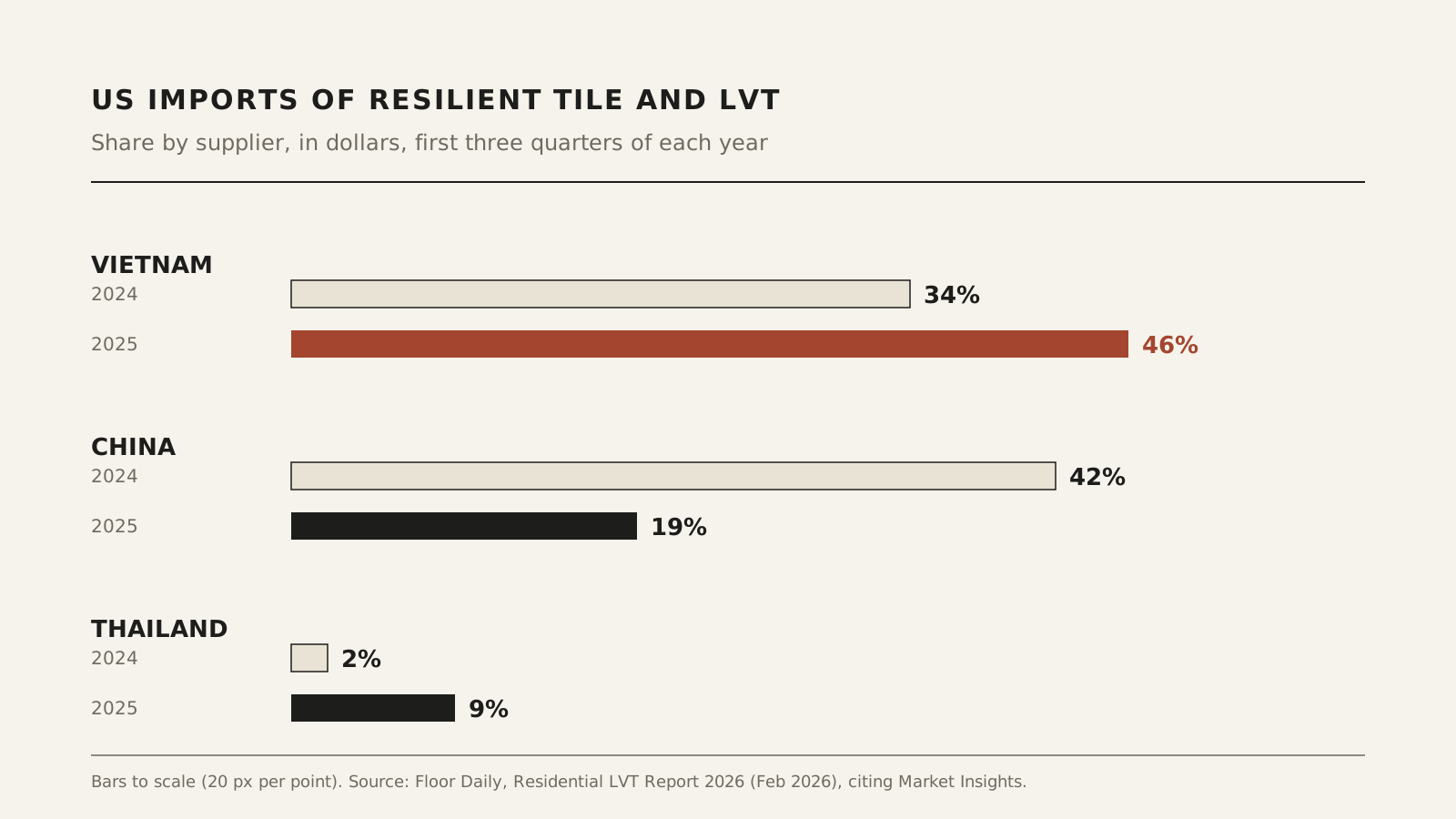
Vietnam flooring market: SPC production, US exports and trade risks
Vietnam's flooring market for importers: where SPC is made, the US import shift (34% to 46%), plant ownership, tariffs and UFLPA, with dated sources.
Read the guideThailand SPC purchase order checklist: what to fix before the deposit
A clause-by-clause PO checklist for Thai SPC plants: seller and site, certificate scope, test editions, packing, release and export data. November 2026.
Read the guide
Vietnam vs Thailand SPC flooring: comparing two factory bases
Vietnam has 13 serious SPC plants, Thailand 10 SPC manufacturers in production. Scale, ports, MOQ and documents compared; US duty is level, Nov 2026.
Read the guide