
Market overview / Reviewed November 2026
Vietnam flooring market: SPC production, US exports and trade risks
Vietnam's flooring market for importers: where SPC is made, the US import shift (34% to 46%), plant ownership, tariffs and UFLPA, with dated sources.
Short answer
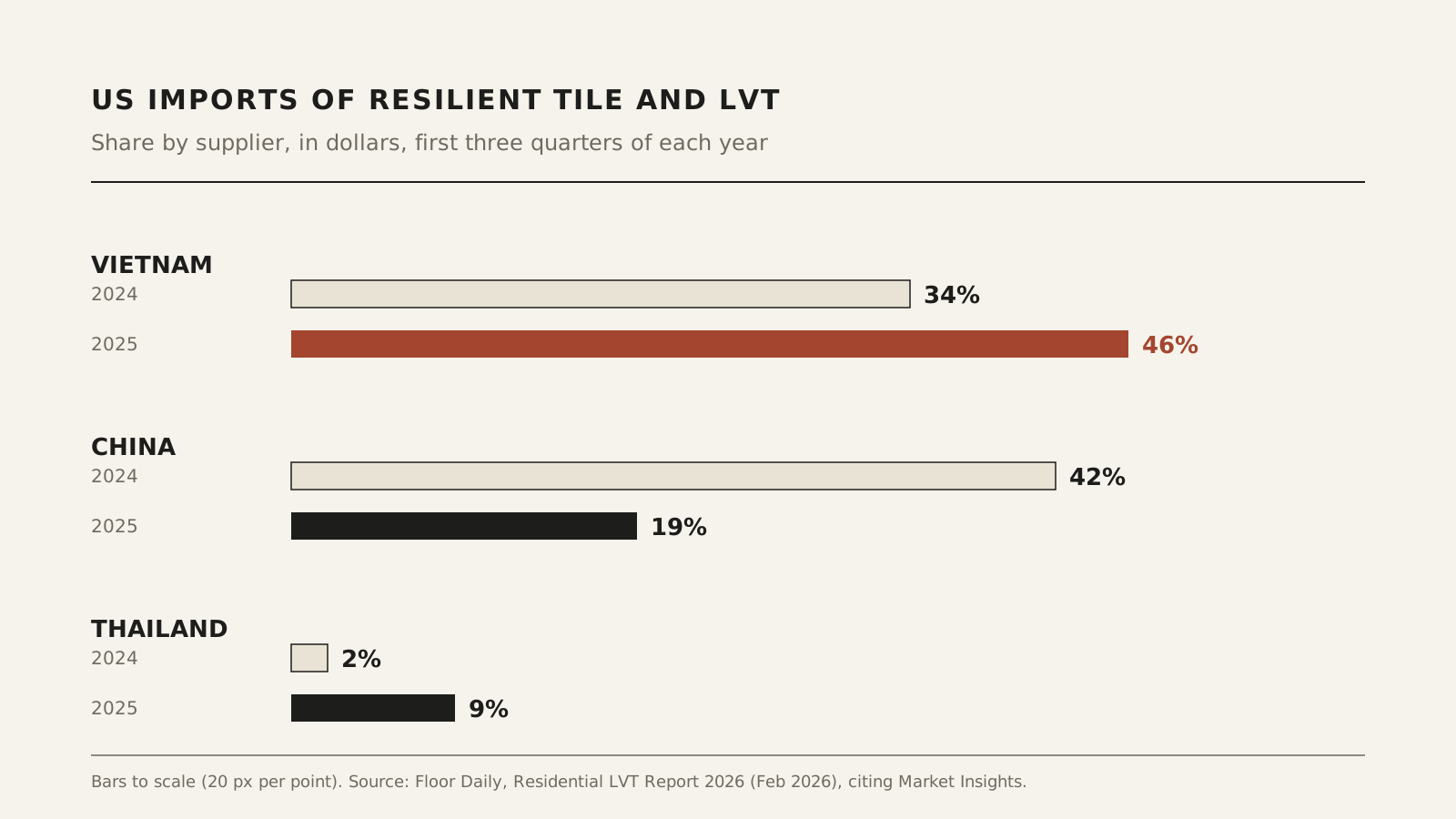
For flooring importers, Vietnam matters mainly as a production base. Its 13 serious SPC plants all sit in the north, from Phu Tho and Thai Nguyen to Hai Phong, Quang Ninh and Ninh Binh. Vietnam's share of US resilient tile and LVT imports rose from 34% to 46% in the first three quarters of 2025, while China's fell from 42% to 19%. Duty and PVC traceability are the risks.
Vietnam is now the largest supplier of vinyl flooring to the US: 46.1% of US imports under HS 3918.10 by value in 2025, against China's 14.0% (UN Comtrade).
Hai Phong holds 4 of Vietnam's 13 serious SPC plants, more than any other province; the rest sit in six other northern provinces.
As of November 2026, Vietnamese-origin SPC under HTS 3918.10.10 pays 5.3% plus a 12.5% Section 301 duty; no US anti-dumping or countervailing order covered vinyl flooring from Vietnam at 26 October 2026.
How big is Vietnam’s flooring industry for importers?
Measured by what it ships, Vietnam is the largest supplier of vinyl flooring to the United States. US imports of vinyl floor coverings from Vietnam came to about USD 2.1 billion in 2025, 46.1% of the total. The production behind that figure sits in 13 serious SPC plants, all in northern Vietnam.
Searches for the Vietnam flooring market mostly return report teasers about domestic demand. Those reports measure tiles, wood and vinyl bought inside Vietnam. An importer needs the other side: where the floor is made, how much of it reaches the US, who owns the plants and what could change the price of the next container.
The table sets out that picture. Each row carries its source and date; the trade figures are by value.
| Measure | Figure | Source, date |
|---|---|---|
| US imports of vinyl floor coverings (HS 3918.10) from Vietnam, 2025 | 46.1% of the total by value, about USD 2.1 billion | UN Comtrade, read 10 Nov 2026 |
| US resilient tile and LVT imports, first three quarters of 2025 | Vietnam 46% (34% a year earlier), China 19% (42%) | Floor Daily, Feb 2026, citing Market Insights |
| Serious SPC plants | 13, all in the north; 4 in Hai Phong | Vietnam factory directory, Oct to Nov 2026 |
| Ownership of those plants (confirmed or probable) | 8 Vietnamese companies, 3 in China-based groups, 1 in an international group, 1 not confirmed | Company documents and filings, Nov 2026 |
| US duty on Vietnamese-origin SPC, HTS 3918.10.10 | 5.3% general rate plus 12.5% Section 301, about 17.8% | USITC HTS and 91 FR 47318, as of Nov 2026 |
| US trade remedy order on vinyl flooring from Vietnam | None | Federal Register search, as of 26 Oct 2026 |
| Forced-labour enforcement | PVC is a UFLPA high-priority sector, since July 2024 | CBP |
The USD 2.1 billion is computed from Comtrade’s 2025 total for US imports under HS 3918.10, USD 4.63 billion, at Vietnam’s 46.1% share. It is US customs value, so it excludes ocean freight and duty.
Where are Vietnam’s SPC flooring factories?
All 13 sit in the north, in a corridor that runs from Phu Tho and Thai Nguyen through Hanoi and Bac Ninh to the coast at Hai Phong and Quang Ninh, with two plants south of Hanoi in Ninh Binh. Hai Phong holds four, more than any other province, and also has Lach Huyen, the deep-water port for northern Vietnam.
The table lists the plants by province, using province names after Vietnam’s 2025 mergers. Locations come from company documents, permits and certificates; a listed site is not proof of current output.
| Province | Plants | Names in the records | Note |
|---|---|---|---|
| Hai Phong | 4 | NEO FLOOR, Hai Phat, An Cuong, CFL | An Cuong’s two factories are in former Hai Duong; CFL’s northern plant was announced in 2024 |
| Quang Ninh | 2 | BBL Home, ANZ Flooring | BBL’s Dong Mai project is in Quang Yen, next to Hai Phong |
| Thai Nguyen | 2 | Huali Group Vietnam, Vietnam Sentai | Both in the Pho Yen area |
| Ninh Binh | 2 | ATT Floor, VN EcoFloor | Former Ha Nam |
| Phu Tho | 1 | AMY | Former Vinh Phuc |
| Hanoi | 1 | VFLOOR / Havitech | Cam Thuong cluster, western Hanoi |
| Bac Ninh | 1 | Vietnam Hengli | Former Bac Giang |
The clustering also means a shortlist of plants in different provinces can be seen in one trip. The map of northern Vietnam’s SPC plants shows the sites against the ports and industrial parks.
How much US flooring does Vietnam supply?
Close to half. Vietnam passed China as the largest supplier of vinyl flooring to the US in 2024 and widened the lead in 2025. Two independent data sets agree on the direction and on Vietnam’s 46%; they differ on China because they measure different product scopes and periods.
The table shows both, so a figure quoted in a sales deck can be traced to its scope.
| Data set | Scope and period | Vietnam | China | Thailand |
|---|---|---|---|---|
| Market Insights, via Floor Daily | Resilient tile and LVT, first three quarters of 2024 | 34% | 42% | 2% |
| Market Insights, via Floor Daily | Same scope, first three quarters of 2025 | 46% | 19% | 9% |
| UN Comtrade | HS 3918.10, all vinyl floor coverings, full year 2024 | 36.9% | 34.1% | Not in this pull |
| UN Comtrade | HS 3918.10, full year 2025 | 46.1% | 14.0% | Not in this pull |
Floor Daily also reports that total US imports of LVT and resilient tile rose 6.3% through September 2025, so Vietnam’s gain came from a larger share of a growing category. The shift is a US story. In 2025 China was still the largest supplier of vinyl flooring to the UK, Canada, Australia and Germany, where Vietnam’s share was small (UN Comtrade).
For the plant-by-plant side of that comparison, the Vietnam against China SPC guide sets the two countries against one specification.
Who owns the plants, and does it change origin?
Ownership is mixed, and it does not set US origin. Of the 13 plants, eight belong to Vietnamese companies and three to groups based in China; CFL belongs to an international group held in Hong Kong, and Hengli’s foreign investor is not named. Origin follows where the core is made and the plank finished.
The Vietnamese companies are NEO FLOOR (Pha Le Group), An Cuong (An Phat Holdings), AMY, VN EcoFloor, ANZ Flooring, ATT Floor, VFLOOR / Havitech and Hai Phat. Huali belongs to China’s Huali Group, Vietnam Sentai to Anhui Sentai WPC Group and BBL Home to Jiangsu BBL Home Technology, through a Singapore holding. CFL Vietnam belongs to the CFL flooring group, held in Hong Kong. The plant-by-plant grades and their sources are in who owns Vietnam’s SPC factories.
For a US entry, CBP ruling N323990 (2022) is the public marker: SPC with a Vietnamese-made core and Chinese surface and backing layers was treated as Vietnamese. A plant that buys in finished core board falls outside it, whoever owns the plant. The records that settle origin for a given order are set out in the made-in-Vietnam origin check.
What can change: tariffs, origin and UFLPA?
Three things can move the cost of Vietnamese flooring in the US: the duty rate, a trade case on vinyl flooring, and a forced-labour detention. As of November 2026 the stack is 5.3% plus 12.5%, no trade case is open on the product, and PVC resin is under forced-labour scrutiny.
The timeline lists each US measure with its status at the date shown. It is a dated record, not a forecast.
| From | Measure | Status, November 2026 |
|---|---|---|
| 21 Jun 2022 | UFLPA presumption against goods made wholly or in part in Xinjiang | In force; PVC named a high-priority sector in July 2024 |
| 2025 | IEEPA “reciprocal” tariffs on Vietnamese goods | Voided by the Supreme Court on 20 Feb 2026, as reported |
| Feb 2026 | Temporary Section 122 surcharge | Ended; replaced on 24 Jul 2026 |
| 24 Jul 2026 | Section 301 forced-labour duty, 12.5% on products of Vietnam (heading 9903.05.84) | In force; challenge argued at the Court of International Trade on 30 Sep 2026, no ruling by 26 Oct |
| Jul 2026 | Final AD/CVD determination on hardwood and decorative plywood from Vietnam | Not flooring, but a live trade case on a Vietnamese building product |
| Not applicable | AD/CVD order on vinyl flooring from Vietnam | None, as of 26 Oct 2026 |
The 12.5% is the same rate Thailand pays, so it does not change Vietnam’s position against its nearest rival. Against China it is the List 3 duty that matters: Chinese-origin SPC pays a further 25%. The dated US tariff monitor holds the full stack, the court case and the contract clauses we would write.
The forced-labour risk sits in the resin, not the country. A Vietnamese plant that buys PVC traced, or not disproved, to Xinjiang exposes the container to detention whatever the duty rate.
What do capacity claims, certificates and customs records prove?
Each answers one question. Trade statistics show where a country’s exports go. A stated capacity shows what a company says a plant can make. A shipment record shows who shipped what to whom. None of them, alone, shows that a given plant made a given floor.
The table sets out what each kind of record can and cannot carry.
| Record | What it proves | What it does not prove |
|---|---|---|
| Trade statistics (Comtrade, USITC, Market Insights) | Country shares and totals, by value | Anything about one plant or one shipment |
| Stated capacity (website, prospectus, permit) | What the company says a site can make | Actual output, spare room, or your construction |
| Customs shipment records | Who shipped, to whom, how often | That the shipper made the goods; plant size |
| Product certificate (FloorScore and similar) | One product from one listed site met one standard | Origin, capacity or resin traceability |
| Production records and bill of materials | Where your construction was made and from what | Ownership; the origin of other orders |
Shipment data is the piece most often misread. The records of who ships Vietnam SPC show exporters and buyers, and an exporter in those records can be a trading company rather than a plant.
Worked example: from a national share to one plant
An importer reads that Vietnam’s share of US resilient tile and LVT imports rose from 34% to 46%, and that one plant has the capacity for a new programme. The method below separates what each figure carries.
| Step | Figures | Result |
|---|---|---|
| 1. Index the 2024 category | Total US imports, first three quarters = 100 | Vietnam = 34 |
| 2. Apply growth | Total up 6.3% = 106.3 | Vietnam 46% of 106.3 = 48.9 |
| 3. Vietnam’s change | 48.9 / 34 | About +44% in dollar terms |
| 4. China’s change | 19% of 106.3 = 20.2, against 42 | About -52% |
| 5. One plant: BBL’s Vietnam base | Design 26.7m m²; stated 2025 capacity 21.87m m²; 2025 output 15.88m m² | 72.6% utilisation, as stated |
| 6. A new programme | 300,000 m² a year (illustrative) | 1.9% of the base’s 2025 output |
The shares are rounded, so steps 3 and 4 are approximate. The plant figures come from the BBL Home profile, which cites the parent company’s draft Hong Kong listing application and a Quang Ninh permit application; none of them is audited output.
What the arithmetic proves: Vietnam’s dollar sales into this US category grew by about 44% in a year, and this plant reports room beyond its 2025 output. What it does not prove: that the room exists on the line that would run your construction, that the base’s capacity is all vinyl (its stated scope covers PVC and wood flooring), or that the plant’s shipments are of Vietnamese origin. Three documents close that gap: production records for your construction, a bill of materials that names the resin supplier, and shipment records under the plant’s own legal name.
What do market-size reports measure?
They measure demand inside Vietnam, with definitions that do not match each other or the export data. Two vendor estimates are publicly visible and scoped; both cover all flooring sold in Vietnam or all resilient flooring, and neither says how exports are treated.
The figures below are vendor estimates, shown as published on each vendor’s public page. They are not comparable with the trade figures above.
| Vendor estimate | Year | Figure | Scope as stated | Page date |
|---|---|---|---|---|
| IMARC Group | 2025 | USD 1,389.6 million | All flooring types, residential and non-residential | Updated 6 Apr 2026 |
| Grand View Research Horizon | 2024 | USD 252.5 million | Resilient flooring: LVT, vinyl sheet and tile, linoleum, cork, rubber | 5 Nov 2025 |
Set against the USD 2.1 billion of vinyl flooring the US imported from Vietnam in 2025, both estimates describe a smaller market than the export trade. That is the gap an importer should keep in mind: domestic demand reports say little about the plants that make US-bound SPC.
Our view: what would we check first?
Vietnam’s export capacity is large, concentrated in one region and well documented in public filings. The risk sits less in the country than in the plant, the resin and the paperwork. We would start with the plant’s own records for the construction we want, not with the national figures.
On a first order we would check three things before the price. Where the core is extruded for that exact construction. Which resin goes into it, and whether the supplier can be traced. Whether the plant ships under its own legal name, so the customs record and the factory record match.
We would also date every duty assumption. The 12.5% is in court and a vinyl flooring case could open at any time; neither is a reason to avoid Vietnam, but both belong in the contract. Our factory selection support runs that shortlist, the document requests and the supplier meetings in Vietnam for buyers.
The rest of the factory research, including ownership grades and regional maps, sits under Find factories.
Common mistakes: where does a market read go wrong?
Most mistakes come from reading one figure as if it answered another question. The table lists the common ones, what each costs and how to avoid it.
| Mistake | What it costs | How to avoid it |
|---|---|---|
| Quoting a domestic market-size report as Vietnam’s flooring industry | A plan built on the wrong denominator | Use trade data for export questions |
| Taking a stated capacity as available capacity | An order placed on a line that is already full | Ask for output and line allocation for your construction |
| Reading a shipment record as proof of manufacture | A trading company mistaken for a plant | Match the shipper’s legal name to the plant record |
| Treating a Chinese owner as Chinese origin, or a Vietnamese owner as Vietnamese origin | A wrong duty assumption either way | Check where the core is made |
| Using a share figure without its scope | Two decks quoting 14% and 19% for China, both right | Quote the data set, product scope and period with the number |
Questions buyers ask
How big is the Vietnam flooring market?
It depends on which market you mean. Report vendors put domestic flooring demand at about USD 1.4 billion (IMARC, all floor types, 2025). The US alone imported about USD 2.1 billion of vinyl floor coverings from Vietnam in 2025, by UN Comtrade data. For an importer the export figure is the one that describes the industry.
Is Chinese-owned SPC made in Vietnam of Vietnamese origin?
It can be. US origin follows where the floor is made or substantially transformed, not who owns the plant. CBP ruling N323990 (2022) treated SPC with a Vietnamese-made core and Chinese surface layers as Vietnamese. A plant that buys in finished core board is outside that ruling.
What happens to my landed cost if the 12.5% duty is struck down?
The stack on Vietnamese-origin SPC would fall back to the 5.3% general rate, and duty already paid may become refundable. Nobody can promise either. Keep full entry records and agree in your contracts now who receives any refund.
Can I ask a Vietnamese plant to prove it makes what it exports?
Yes, and a serious plant expects the question. Ask for production records for your construction, a bill of materials naming the resin supplier, and shipment records under the plant's own legal name. A plant that offers only a certificate of origin has answered a different question.
Where do I follow changes to the Vietnam flooring industry?
Duty rulings, trade cases and plant openings move faster than this overview. Our [market news feed](/intelligence/) records them as they happen, and this page is reviewed when a change alters the picture.
Sources & further reading
- Floor Daily, "Residential LVT Report 2026", February 2026: US resilient tile and LVT import shares, citing Market Insights
- UN Comtrade, reporter USA, imports of HS 391810 by partner, annual 2019 to 2025 (read 10 November 2026)
- Federal Register, 28 July 2026 (91 FR 47318): actions in the Section 301 investigations of 60 economies
- USITC Harmonized Tariff Schedule, Chapter 99, 2026: heading 9903.05.84, products of Vietnam
- CBP, July 2024: UFLPA strategy update names PVC a high-priority enforcement sector
- CBP ruling N323990 (22 February 2022): country of origin of SPC flooring produced in Vietnam
- IMARC Group, Vietnam flooring market report page, updated 6 April 2026 (vendor estimate)
- Grand View Research Horizon, Vietnam resilient flooring market outlook, 5 November 2025 (vendor estimate)
Authorship, affiliations & disclosure
Prepared from the trade statistics, US tariff schedule, Federal Register notices, CBP material and factory documents listed, read between 26 October and 18 November 2026. Vendor market-size figures are shown as published and are not endorsed. The worked example uses the published figures of one plant and an illustrative order size, not prices. No factory visit, audit or test is reported.
Corrections & editorial informationContinue exploring.
All guides in Find factories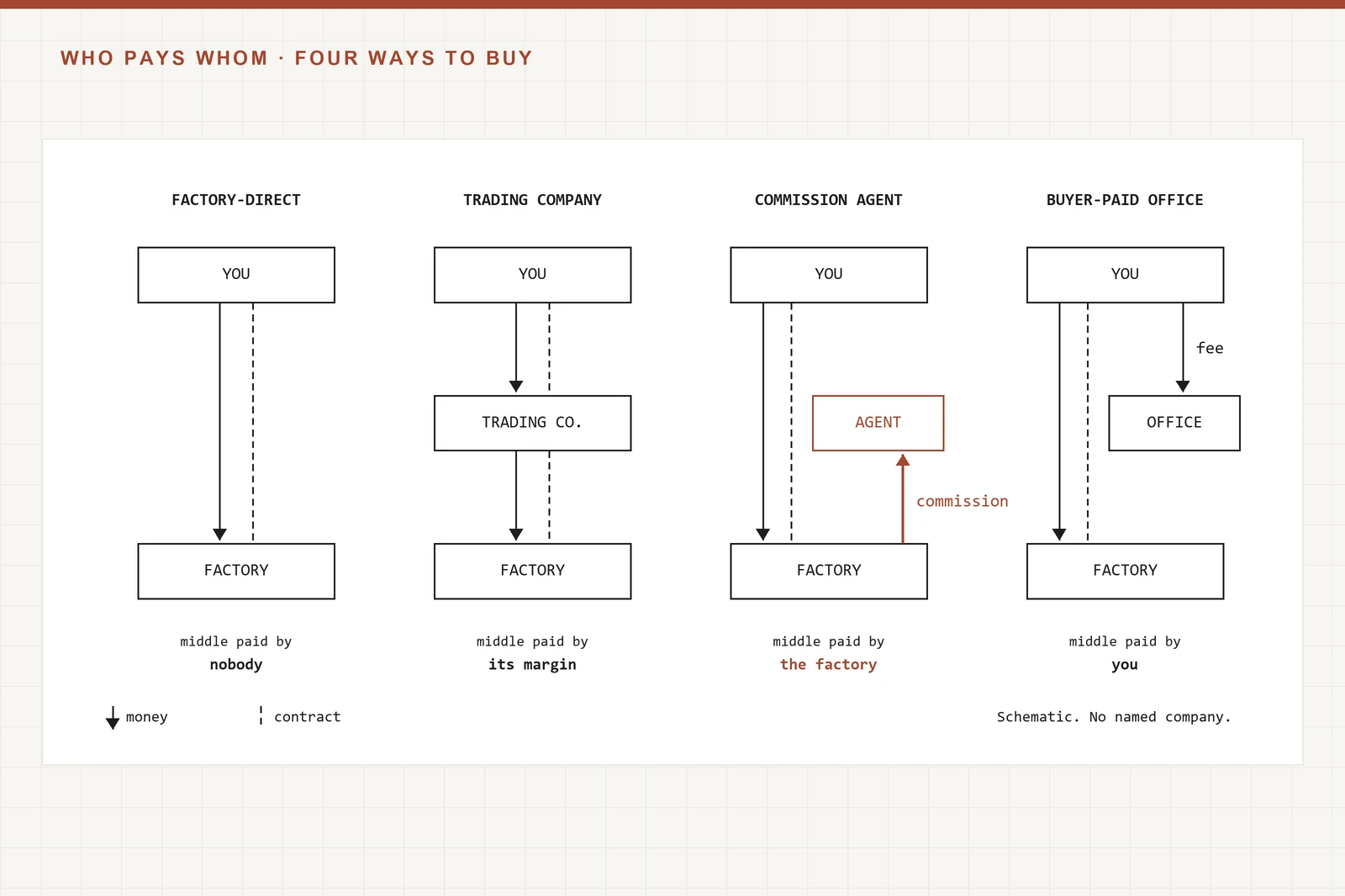
Flooring sourcing agent in Vietnam: who pays them, when you need one
Four ways to buy flooring from Vietnam, who pays the middle party in each, and how a factory-paid commission hides in the price per m².
Read the guideThailand SPC purchase order checklist: what to fix before the deposit
A clause-by-clause PO checklist for Thai SPC plants: seller and site, certificate scope, test editions, packing, release and export data. November 2026.
Read the guide
Vietnam vs Thailand SPC flooring: comparing two factory bases
Vietnam has 13 serious SPC plants, Thailand 10 SPC manufacturers in production. Scale, ports, MOQ and documents compared; US duty is level, Nov 2026.
Read the guide