
Verify factories / Product checks
SPC click joint test: locking strength, gaps and which standard
ISO 24334 tests SPC locking strength; ISO 24337 measures openings and height differences. Which report to ask for at sample, production and shipment.
Short answer
An SPC click joint test should answer three questions for the construction you are buying: is the milled profile to drawing, does the assembled joint sit closed and flat, and how much force opens it. ISO 24334 covers locking strength; ISO 24337 covers openings and height differences between assembled elements. Test long and short sides separately and repeat after tooling or recipe changes.
ISO 24334:2019 is the locking-strength method; the 2014 edition pulled a joint apart to a 0.20 mm opening or until the lock broke. ISO set the standard to "to be revised" in March 2026.
Both ISO methods were written for laminate and say they can apply to other mechanically assembled panels. Neither sets a pass value, so the limit goes in your PO. ASTM F3781 edge strength has a programme minimum: 17 lbf under SCS-111 v2.1.
A profile scan and a lab report answer different questions. Approve the joint only on a report that names the ordered construction, each joint side and the agreed limit.
What should an SPC click joint test establish?
Three separate things: the milled profile matches the drawing, the assembled joint closes flat, and the lock holds under a pull. Suppliers often send one of these as proof of all three. A profile scan does not measure strength, and a strength figure does not show a gap or a step. Ask for each answer on the construction you ordered.
The table sets out which evidence answers which question. Standards and editions are from the ISO and CEN records listed under Sources, read in November 2026.
| Question | Evidence | Method or tool | What it cannot tell you |
|---|---|---|---|
| Is the profile milled to drawing? | Profile measurement per tool or shift | Factory gauge, projector or laser scanner | Whether the assembled joint holds |
| Does the assembled joint close flat? | Openings and height differences between assembled boards | ISO 24337:2019 | Force needed to open the joint |
| How much force opens the joint? | Locking strength per joint side | ISO 24334:2019, tensile machine | Gaps and steps on a laid floor |
| Does it behave on a real floor? | Test floor from boards of different pallets | Inspector’s visual and feeler check | A lab value you can compare between suppliers |
One click-technology owner describes its measuring machine as checking “the accuracy of the milled click profiles in a fast and non-destructive way”. That is a geometry check. Its page reports no locking-strength value.
None of these four checks shows whether the joint keeps standing water out. That is a separate test, covered in what proves a waterproof SPC claim. A bright line along a closed joint may also be a bevel defect rather than an opening.
Which standards apply to a rigid-core click joint?
The two ISO methods were written for laminate, and both say they can also apply to other mechanically assembled panels such as modular multilayer floorings. Neither sets a pass value. A pass limit comes from a product standard you declare against, or from your contract. Name the edition in the PO, because ISO 24334 is being revised.
- ISO 24334:2019 (edition 3, July 2019) specifies a method for the locking strength of joints with vertical and horizontal mechanical locking. ISO confirmed it in March 2025, then set it to “to be revised” on 26 March 2026, with a committee draft under development.
- ISO 24337:2019 (edition 2, confirmed April 2025) covers thickness, length, width, squareness, straightness, flatness, openings between assembled elements and height differences between assembled elements.
- ISO 24342:2024 (edition 4) covers side length, edge straightness and squareness of resilient tiles and planks. A plank that is out of square opens a gap however good the profile is.
- EN 16511 (2023 edition) covers multilayer mechanically locked panels for floating installation and lists ISO 24334:2019 among its references. Its requirement tables are not reproduced here; take values from the standard itself.
- ASTM F3781-25 loads the profiled edge vertically until it fractures. It is an edge-strength test, not a locking-strength test, and is covered in its own section below.
Who owns the profile design, and whether the factory may use it, is a separate question covered in our guide to click licences for importers.
Where each joint failure shows up
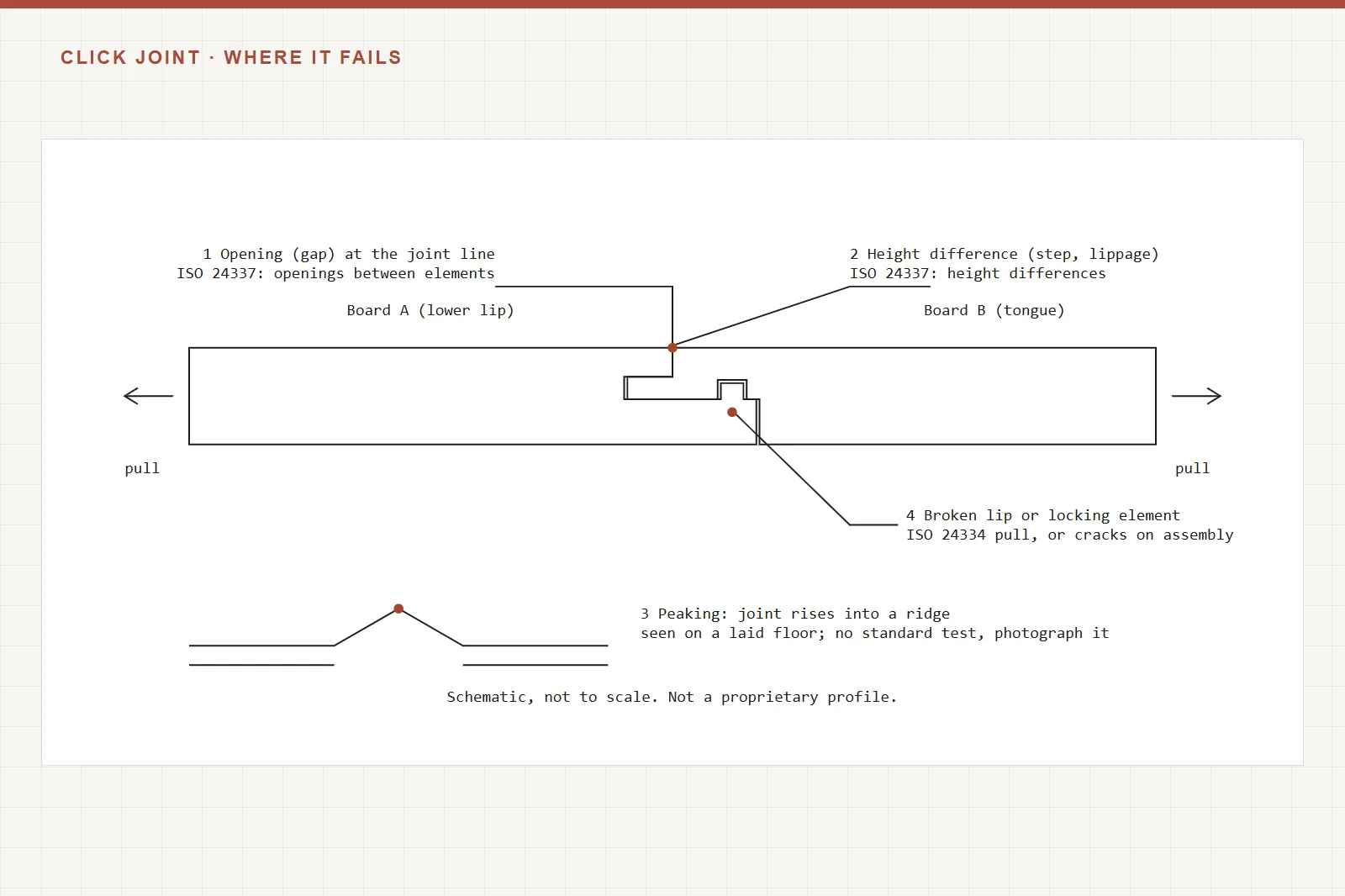
Four failures matter, and they are measured in different places. Gaps and steps sit on the surface joint line and fall under ISO 24337. A broken lip or locking element shows in the ISO 24334 pull test or during assembly. Peaking shows only on a laid floor; record it with photographs.
What should be tested at sample, in production and before shipment?
Lab tests belong at sample approval, because they fix the baseline. Production needs fast checks the factory can run at every tool change. Pre-shipment needs a laid test floor from boards of different pallets. Each stage checks against the stage before it, so a missing sample result leaves the later checks with nothing to compare.
The split below is our recommended buyer plan, not a requirement of any standard.
| Stage | Joint check | Who runs it | Decision it supports |
|---|---|---|---|
| Sample approval | ISO 24334 both sides; ISO 24337 openings and height differences; ASTM F3781 if the product will carry a certification that requires it | Independent lab, on the ordered construction | Approve profile and construction; fix the limit |
| First production boards | Profile gauge reading; assembly of boards from the run | Factory, witnessed or with records | Release the full run |
| Each tool change or recipe change | Profile reading; repeat assembly; retest if the profile drawing changed | Factory, report to buyer | Continue or stop the line |
| Pre-shipment | Test floor from different pallets; gaps, steps, broken lips, peaking | Inspector | Release or hold the lot |
The production stages sit inside the wider SPC production hold points, where first production boards are the release that matters most. Keep a few of the same boards for the wear layer check, so both results describe one board set.
How do you read a locking-strength lab report?
Check identity before the number. The report should name the method edition, the construction tested, each joint side and how specimens were prepared. A strong figure on a thinner board, a padless build or one side only is evidence about a different product. The 2014 edition’s clauses show what a complete report describes.
What the ISO 24334:2014 preview requires, and what to look for. Confirm each point against the 2019 edition the lab applies.
| Report field | What the 2014 edition says | What to check |
|---|---|---|
| Method and edition | Not applicable | “ISO 24334:2019” named, not “ISO 24334” alone |
| Sampling | Five panels, preferably from one package; five short-side and five long-side specimens | Both sides tested, specimen count stated |
| Conditioning | Constant mass at (50 ± 5) % RH and (23 ± 2) °C | Conditioning stated, not skipped for speed |
| Assembly | Joints connected per the manufacturer’s fitting instruction | Angle-in or fold-down as the installer will do it |
| Principle | Pulled apart to a 0.20 mm opening or until the lock breaks | Which end point each specimen reached |
| Construction | Specimen width and thickness measured | Thickness, pad and core revision match your order |
Record the failure mode for each specimen. A joint that reached the opening and a joint whose lip snapped can give similar forces and mean different things for a floor. The tensile machine in the 2014 edition is verified to ISO 7500-1, class 3; ask the lab for its calibration date.
Where does ASTM F3781 edge strength fit?
ASTM F3781 answers a different question from ISO 24334. It loads the profiled edge of a floating modular plank vertically, at a set speed, until the edge first fractures; ISO 24334 pulls an assembled joint apart. A plank sold as ASSURE CERTIFIED rigid core flooring must reach at least 17 lbf (about 75.6 N) under it.
The method is ASTM F3781-25 (committee F06, listed as active in November 2026). Its catalogue page explains the reason for the test: brittle or over-flexed edges can fracture and cause ledging and gapping, and edges that are too soft can come unhinged. The page also says results may correlate with the ISO 4918 castor chair test used to judge lock integrity. ASTM sets no pass value; the minimum comes from the certification programme.
Which programmes require it
SCS Standards and Assurance Systems added F3781 testing to its SCS-111 standard for rigid core resilient flooring in version 2.0 (October 2025). Version 2.1, released on 12 August 2026, sets the 17 lbf minimum for the profiled edges. SCS-111 underpins the ASSURE CERTIFIED programme run by SCS Global Services. New applicants are audited against version 2.1; existing certificate holders move to it at their next annual audit, and every holder must be audited against it by 31 May 2027.
Outside that programme, none of the sources read for this guide sets an F3781 minimum. If a retailer or specifier names the method without a figure, the limit becomes a contract term, as with ISO 24334.
Tying an edge-strength report to one SKU
A report proves the boards that were tested. Ask for the factory product code and your PO item number on the report, with board thickness, attached pad, core recipe revision and the profile drawing and tool reference. Have your inspector pick and mark the boards from the approved sample batch, and keep marked boards from the same batch as a reference set.
When the factory’s own report is not enough
For ASSURE CERTIFIED, SCS said in January 2026 that F3781 testing must be completed by an independent laboratory, so an in-house result does not qualify. Outside the programme an in-house result tracks production, but it does not approve a sample when it names another construction or profile revision, gives no edition, or predates a tooling or core change.
What to request before approving a plank that must meet F3781. The programme figure and date are from the SCS release of 12 August 2026; the rest is our recommended practice.
| Request | Why | Reject if |
|---|---|---|
| Report to ASTM F3781-25, edition named | Fixes the method used | “ASTM F3781” alone, or another edge or pull test |
| Laboratory name and its accreditation scope | ASSURE CERTIFIED needs an independent lab | Factory in-house lab only |
| Product code, PO item, thickness, pad, core and profile revision | Ties the result to one SKU | “SPC 5 mm” or a product range |
| Result for each profiled edge, individual values and fracture description | Shows the weakest edge | A single mean with no edge named |
| Statement against 17 lbf (SCS-111 v2.1) or your agreed limit | Turns a number into a decision | No limit stated |
| Current certificate listing your product | Certification covers named products only | Certificate for other products from the plant |
| Retest clause for profile, tooling, core or pad changes | Keeps the report valid for later lots | No retest trigger in the PO |
Suggested retest wording, to adapt with your adviser:
Edge strength of the profiled edges shall be tested to ASTM F3781-25 (or the edition named in this PO) by an independent laboratory on boards of [product code, PO item] in the approved construction [board thickness, pad, core recipe revision, profile drawing and revision]. The profiled edges shall meet or exceed [17 lbf where the product is sold as ASSURE CERTIFIED, or the agreed value]. A change of profile drawing, click tooling, core recipe, board thickness or pad voids this report; the supplier shall retest before shipment and send the new report naming the changed revision.
Worked example: a report that does not cover the order
An illustrative buyer orders a 5.0 mm rigid-core plank with a 1.0 mm attached pad. The factory sends a locking-strength report as proof. On reading, the report covers a different build, so it supports the profile design family but not the order. The buyer asks for a retest before approving the sample.
Illustrative figures only; no real report or factory.
| Field | Order needs | Report shows | Action |
|---|---|---|---|
| Method | ISO 24334:2019 | “ISO 24334”, no edition | Ask for the edition |
| Construction | 5.0 mm board + 1.0 mm pad | 4.0 mm board, no pad | Retest on ordered build |
| Sides | Long and short | Long side only | Add short side |
| Specimens | Count stated per side | Three, no sampling note | Ask for the method’s count |
| Failure mode | Per specimen | Mean force only | Ask for individual results |
The retest runs on boards from the approved sample batch, both sides, with individual results and failure modes. The buyer writes the agreed per-side limit into the PO from that result and repeats the check on first production boards.
What should the purchase order say about joint tests?
Name the method, edition, sides, construction, who tests, the limit and what triggers a retest. Without those fields a factory can satisfy the clause with any report it already holds. Our product development support writes these clauses into the specification before the sample is approved.
Suggested wording, to adapt with your adviser:
Locking strength of long-side and short-side joints shall be tested to ISO 24334:2019 (or the edition named in this PO) on boards of the approved construction [board thickness, pad, core revision], by [laboratory]. The report shall state each side separately, number of specimens, conditioning, assembly method, individual results and failure mode. Acceptance: [agreed value per side]. Openings and height differences between assembled boards shall be measured to ISO 24337:2019; acceptance: [agreed values]. Any change of click tooling, profile drawing, core recipe or pad requires a new locking-strength test before shipment, at the supplier’s cost.
Our view
We would not approve an SPC sample on a click report the factory already had. We would ask for a test on the ordered construction, both sides, with failure modes, and write the result into the PO as the limit. If the range will be sold as ASSURE CERTIFIED, we would have the F3781 edge test run on boards from the same batch at the same independent lab. Then we would hold the factory to it at first production boards and on a test floor before shipment, booked through our pre-shipment inspection service.
The lab test is the expensive one, and it is done once per construction. The gauge reading and the test floor are cheap and repeated. That order of work keeps the number in the report connected to the boards in the container. For the inspector’s side of the test floor, use the SPC pre-shipment checklist.
Common mistakes with click joint tests
Most failures come from accepting evidence about another product, not from a weak test. The table lists the common ones, what each costs the buyer and the fix.
| Mistake | What it costs | How to avoid |
|---|---|---|
| Accepting a profile scan as a strength result | No locking-strength evidence for your order | Ask for an ISO 24334 report on your build |
| Long side tested, short side assumed | End-joint gaps on site | Test both sides, report separately |
| Report on a thinner or padless board | Result does not describe your product | Match thickness, pad and core revision |
| No edition named | Results not comparable on repeat orders | Name ISO 24334:2019 or the PO edition |
| No limit in the PO | A low result cannot be rejected | Write the per-side limit before production |
| No retest after a tooling change | New profile ships on old evidence | Make tool and recipe changes a retest trigger |
| Reading an F3781 result as locking strength | No evidence on the joint under a pull | Ask for ISO 24334 and F3781 as separate reports |
If the joint passes, the next question for the same sample is how to turn it into a specification the factory can repeat.
Questions buyers ask
Can the factory run the locking-strength test in house?
It can if it has a calibrated tensile machine and runs the named method, and in-house results are useful for tracking production. For approving the sample, ask for an independent lab report or witness the in-house test, and compare the two once so you know how far they differ.
What happens if the long side passes and the short side fails?
Then the joint is not approved. Both sides are part of the product you sell, and the long-side result says nothing about the end joint. Ask the factory what changed on the short-side profile or tooling and retest that side before approving production.
Does a report on the same board without the attached pad count?
Treat it as a different construction. A report describes the boards that were tested, so a result on a padless board does not describe a padded one. Ask for a retest on the ordered build, or a written reason from the lab why the result transfers.
Can I ask the factory to test boards from my production run?
Yes, and it is the better evidence. Name in the PO that boards for the test come from the first production boards or a tool change, picked by you or your inspector, not from the showroom stock that produced the sample result.
Does an ASSURE CERTIFIED certificate held by the factory cover my private-label plank?
Only if your product is within its scope. Ask for the certificate and check that your construction, by product code or specification, is listed. A certificate for other products from the same plant does not describe yours, and it cannot carry the claim on your packaging until it is covered.
Who sets the pass limit if ISO 24334 is only a method?
You and the factory, in writing, before production. Use the limit in the product standard you declare against, if it has one, or the approved-sample result with an agreed allowance. A report without a limit tells you a number, not a decision.
Sources & further reading
- ISO 24334:2019, Laminate floor coverings: determination of locking strength for mechanically assembled panels (edition 3; life cycle read November 2026)
- ISO 24334:2014 official preview, clauses 1 to 6 (second edition, superseded)
- ISO 24337:2019, Laminate floor coverings: determination of geometrical characteristics (edition 2, confirmed 2025)
- ISO 24342:2024, side length, edge straightness and squareness of resilient tiles and planks (edition 4)
- EN 16511:2023, modular mechanical locked floor coverings (MMF), Austrian Standards listing
- ASTM F3781-25, fracture resistance of a modular resilient flooring profiled edge to an applied vertical force (catalogue page, read November 2026)
- SCS Standards and Assurance Systems, final revised SCS-111 v2.1 for rigid core resilient flooring, release of 12 August 2026 (copy published by RFCI)
Authorship, affiliations & disclosure
Prepared from the ISO and CEN catalogue records and the ISO 24334:2014 preview listed, read on 10 November 2026, and the ASTM F3781 catalogue page and SCS release notices, read on 11 November 2026. The ASTM F3781 full text was not read. Method details are quoted from the 2014 edition and labelled as such; confirm them against the 2019 text. The worked example is illustrative. We did not test any product for this guide.
Corrections & editorial informationContinue exploring.
All guides in Verify factories
How to check an SPC wear layer before you approve the order
Measure the clear layer in a cut cross-section to ASTM F410 or ISO 24340. 1 mil is exactly 0.0254 mm. What a sample proves about the core.
Read the guide
SPC click licences: what an importer should check
Check 4 links between producer, click technology, territory and cartons. Licensor guidance separates a licence from click-joint quality control.
Read the guide
Read the certificate, not the badge.
Use 6 document checks to match flooring claims to your order. Issuer guidance separates product certification, management systems and site audits.
Read the guide